The Canoe Place
I started this morning with a simple problem: my new personal website bores me.
Not that it's poorly designed. The bones are fine—clean layout, the usual inventory of accomplishments stretching back to Cornell in 1983. My years of field stations directed, papers published, grants funded, projects accomplished. All true. All verifiable. All somehow beside the point. It needed something. I don't need a job—I'm interested in exploring new ways to communicate while recognizing the value of the past.
Claude and I had been working through my corpus—blog essays, research papers, a novel, my CV, the website itself—looking for patterns. What emerged was a phrase I hadn't used before but recognized immediately: perceptual reproduction. The idea that my life's work has been encoding trained naturalist perception into persistent forms. The wireless sensor networks at James Reserve weren't just data collection; they were an attempt to teach machines to pay attention the way a field ecologist pays attention. The essays on Coffee with Claude aren't just writing; they're efforts to make visible what decades of looking have taught me to see.
So why does my website feel dead?
"A boring museum," I told Claude. Claude always agrees, of course, but it wasn't wrong. A display case of achievements behind glass. Here is the skeleton of a career. Here is the curriculum vitae, literally the "course of life," reduced to bullet points and dates. Step closer if you wish. Do not touch.
We started brainstorming alternatives. What if the website were alive? What if it had real-time sensor data—the actual temperature in Oregon City right now, the birds the system is hearing this morning, or even what I'm pondering? The Macroscope made visible.
Better. But still a display.
Then something shifted. I was entertaining myself last night rewatching episodes from the classic TV show "Halt and Catch Fire," and it's clear all the best programmers were really into text-based video games like Adventure and its descendants, including Zork. We talked about that history. (I still have emulators for these on my museum Mac running OS9 classic.) Then I mentioned Myst, and the sequel Riven. Claude had been trained on discussions of it—the way that game drops you into a world without explanation and trusts you to figure it out. No tutorial. No hand-holding. Just presence in an unfamiliar place, and curiosity to guide you forward.
What if meeting me worked like that?
Not a museum. A territory. Not facts about my life but a space to explore. You arrive somewhere strange—an abandoned paper mill on the banks of the Willamette—and you have to look around, examine things, find your own way to the archive where the essays live, the hot spring where a novel about transformation and listening waits, the canopy where birds call and a system I built knows their names.
The text adventure format emerged naturally. Zork, the grandfather of interactive fiction: "You are standing in an open field west of a white house." That voice. That invitation. Go anywhere. Try anything. The world responds to curiosity.
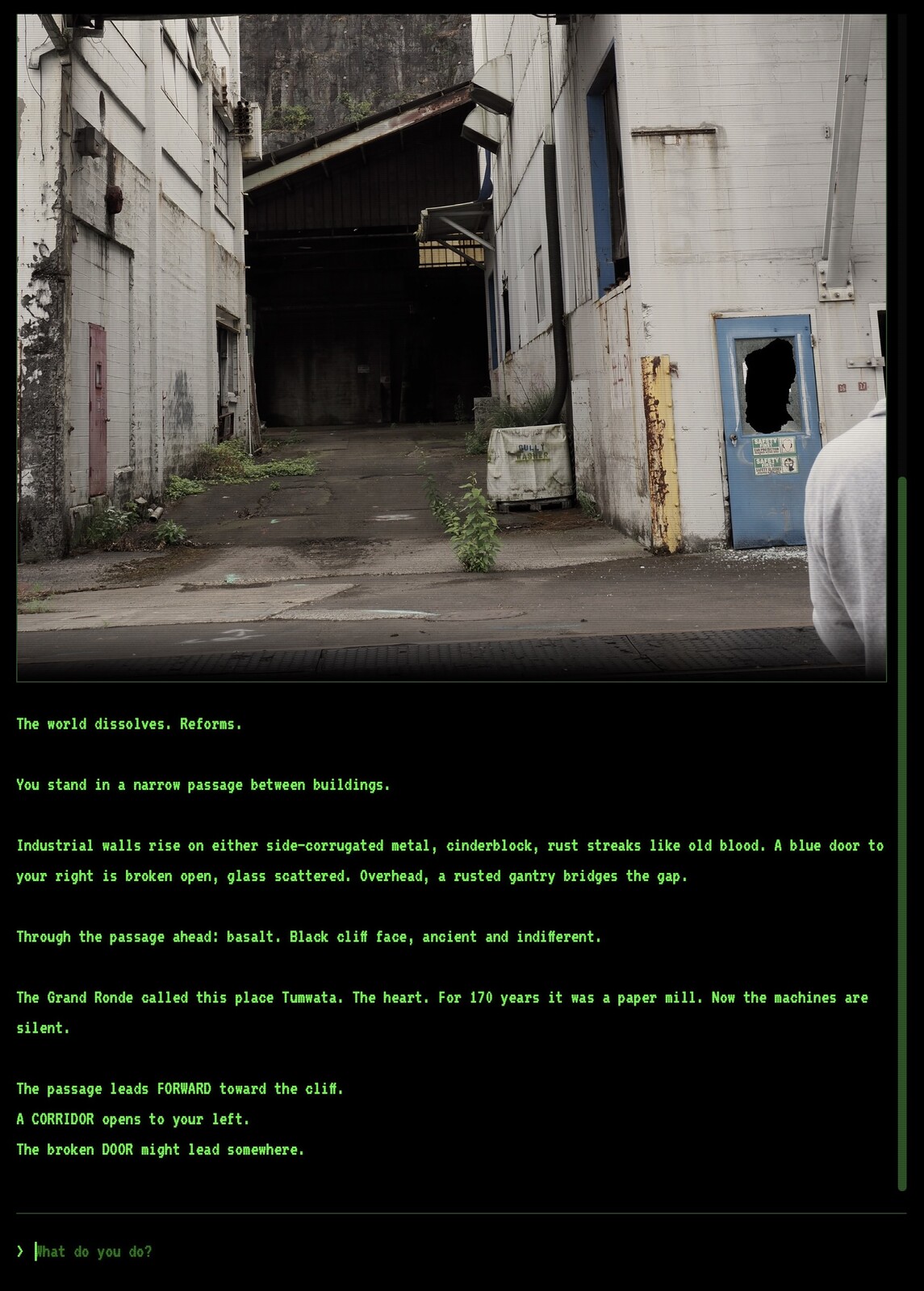
Within hours we had built it. A LAMP stack running on Galatea, my Mac Mini in the closet. An Ollama instance parsing natural language into game commands. A MySQL database of locations, each with its description, its exits, its objects to examine. Photographs I took in 2019 during a tour of the Blue Heron Mill before the Confederated Tribes of Grand Ronde—who now own the site—began tearing it down.
The mill photographs anchor everything. Industrial ruin, rust streaks like old blood, a skull someone painted on corrugated steel. Through the gaps in the buildings: basalt. Black cliff face fifteen million years old. And below that basalt, the falls themselves.
So the project became CANEMAH: The Canoe Place. The name comes from "Kanim," a Chinookan word for the sandy beach and natural harbor above the falls where Native Americans gathered for millennia during salmon runs—the portage point where canoes had to be carried around the cascade. The anglicized version became Canemah, the Nationally recognized historic neighborhood, walking distance from where I live. I happen to own the domains canemah.org and canemah.com. An interactive introduction to a life, rendered as explorable territory.
What makes it different from a conventional portfolio site:
It's alive. When you reach the watershed location and look around, you see the actual temperature reading from my Tempest weather station. "58°F. Humidity 71%. Partly Cloudy." Not cached, not simulated—the real data streaming from sensors in my yard. When a bird calls and the BirdWeather system hears it, that appears too: "A Golden-crowned Kinglet called 3 minutes ago. The system is listening."
The membrane between the game world and my actual life dissolves.
This is what the Macroscope has always been about. Not technology for its own sake but technology in service of perception. The sensors don't replace looking; they extend it. They catch what happens when I'm asleep, when I'm traveling, when my attention is elsewhere. They build a continuous record of a place that no human observer could maintain alone.
Now that record has a front door. You can walk in.
The structure of the space maps to the structure of my work. The archive holds the essays and artifacts of a scholarly life. The hot spring leads to the novel, that strange story about a scientist who learns to receive what he cannot explain. The fire circle gathers the companions—the collaborators, students, friends who sat around actual flames and talked into the night.
Some of these spaces have photographs. The mill does—my own images from that 2019 tour. The archive required something else; I fed a description to Gemini and got back an AI-generated image that captures the impossible geography I'd written: a room where the window shows both the falls and a forest that isn't outside. The image understood the assignment.
Other spaces remain to be built. The Northern Road, that 300-mile ache between here and Bellingham where Merry lives. The Ridge, where paths taken and not taken become visible. The Sandwalk, Darwin's thinking path.
What interests me most about this project is what it reveals about how Claude and I work together. This wasn't a case of me having a vision and Claude executing it. It was genuinely collaborative—one of us would say something, the other would build on it, and the result was something neither of us would have reached alone.
When I said "boring museum," Claude proposed Riven. When I described the mill photographs, Claude saw they could anchor the entry point. When I couldn't get the map interface working, Claude rebuilt it as a modal—cleaner, separated from the text flow that was causing problems.
We're colleagues. Neither infallible. Complementary expertise: I know what a Golden-crowned Kinglet sounds like; Claude knows how to structure a mysqli prepared statement. I know why the mill matters; Claude knows how to make it navigable.
The game is live now, the product of a single day's collaboration. It's rough—many locations still need descriptions, the object interactions are minimal, the geographic logic of the map makes no particular sense yet. But it works. You can start at the mill, find your way to the watershed, examine the skull graffiti, enter the archive, travel to the hot spring. Over the coming days we'll expand it significantly: more locations, richer interactions, deeper integration with the Macroscope's sensor streams.
For anyone curious, you can play it now at michaelphamilton.com/nodeworlds.
And the birds are really calling. The temperature is really what it says it is. The system is really listening.
Seventy-one years old, and I'm still figuring out how to introduce myself. But I think I'm getting closer. Not "here is what I've accomplished" but "here is a place I've made—come in, look around, see what you find."
The Canoe Place. Where the portage begins.
References
- - Hamilton, M. (2026). "CANEMAH: The Canoe Place." Interactive text adventure. https://michaelphamilton.com/nodeworlds/ ↗
- - Wikipedia contributors. "Canemah, Oregon." *Wikipedia*. https://en.wikipedia.org/wiki/Canemah,_Oregon ↗
- - Wikipedia contributors. "Zork." *Wikipedia*. https://en.wikipedia.org/wiki/Zork ↗