
Woo the Muse of the Odd
This morning Cory Doctorow’s Pluralistic newsletter landed in my inbox with a piece called “Deplatform Yourself,” and it sent me tumbling back through thirty-five years of building things on the internet that almost nobody was watching. Doctorow was riffing on Ryan Broderick’s argument in Garbage Day that, in a world where algorithmic platforms have commodified every form of attention, the only remaining zone of authentic cultural resistance is content that platforms cannot monetize — and therefore cannot tolerate. The coolest thing you can do now, Broderick argues, is to pre-deplatform yourself. Walk away from the places where people expect to find you. Make things that can’t be sold.
Doctorow threads this through a lineage I know well. He reaches back to Bruce Sterling’s 1991 keynote at the Computer Game Developers Conference — a blistering, funny, deeply serious talk called “The Wonderful Power of Storytelling,” in which Sterling told a room full of game designers to stop trying to be respectable and start being dangerous. Sterling borrowed a phrase from Lafcadio Hearn, a writer of such profound obscurity that his work has survived for more than a century precisely because no marketing department would know what to do with it: “woo the muse of the odd.” And then Doctorow connects Sterling to William Gibson, whom he interviewed in 1999 and asked what happens to counterculture when commodification becomes instantaneous. Gibson’s answer was haunting: the recommodification machine keeps getting faster, the grace period keeps shrinking, and the biodiversity of culture is genuinely in danger.
I read all of this with a particular kind of recognition. Not because I set out to deplatform myself — I never had a platform to deplatform from. I have never maintained a Facebook account, never posted to Instagram, never tweeted. I have a LinkedIn profile that exists solely so former colleagues can find my email address. My relationship to the internet has always been instrumental in the deepest sense: I built things because they solved problems, and I put them online because that’s where the people who needed them could reach them.
Let me tell you how this started. In the early 1990s, I was directing the James San Jacinto Mountains Reserve, a University of California biological field station perched at 5,600 feet in the San Jacinto Mountains above Idyllwild, California. I had already been director for eight years when the web became available to me. Before that, everything ran through a two-wire analog telephone system so primitive it belongs in a museum. Students and faculty who wanted to visit the reserve called me on that phone. They asked about conditions, availability, access. I answered as best I could, one caller at a time.
When the opportunity came, I was the first natural reserve director in the entire University of California system to register a dot-edu domain. The result was jamesreserve.edu, and it was free under ICANN's rules at the time. I didn’t build it to attract an audience. I built it because researchers needed to know whether it was snowing before they drove two hours up Highway 243, and because I was tired of answering the same questions on a telephone that dropped calls when the wind blew.
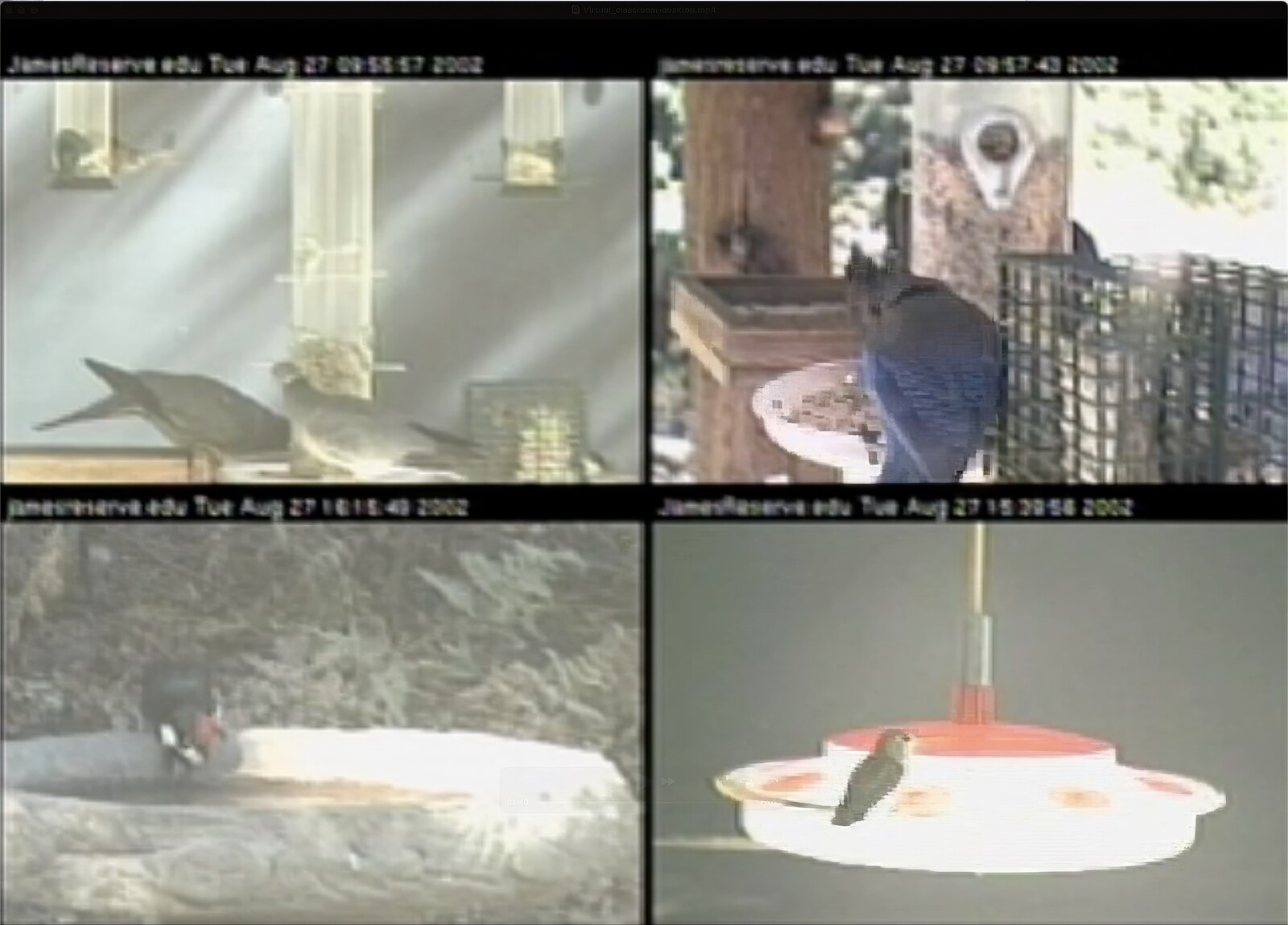
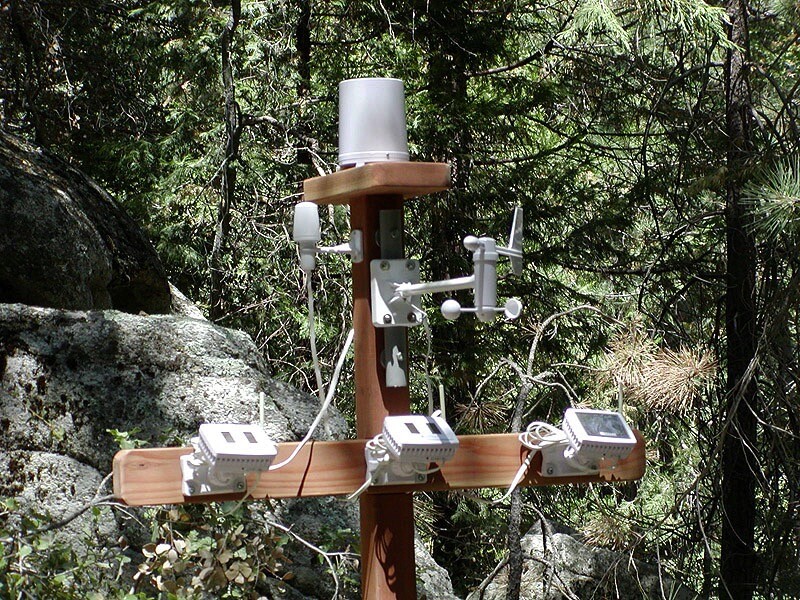
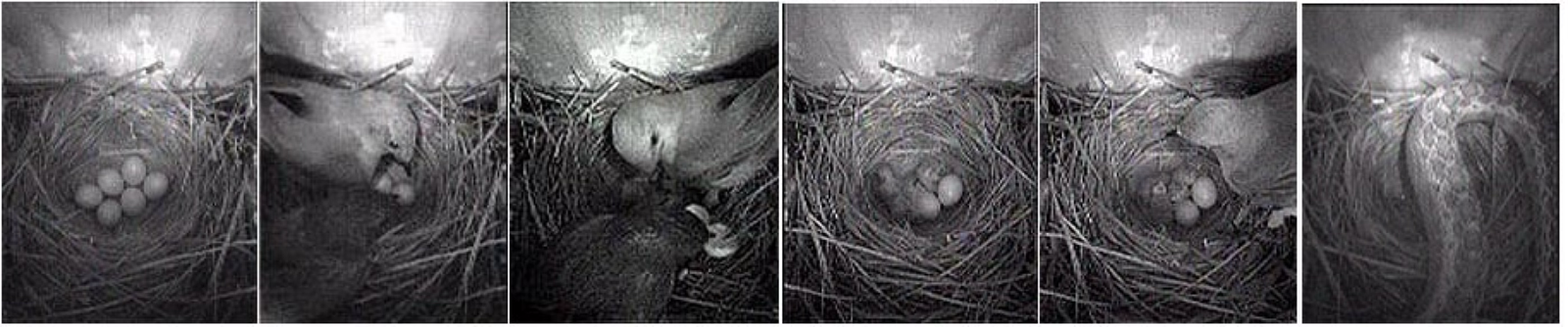
So I started experimenting. I hung cameras on the building and pointed them at bird feeders. I put one inside a Western Bluebird nest box. That nest box camera, mounted ten feet from my office window, produced one of the internet's earliest wildlife dramas. A viewer in New Jersey — watching the live feed three thousand miles away — saw a gopher snake enter the box and frantically emailed me. By the time I read the message, the snake had six perfectly delineated egg-and-chick-shaped lumps, worthy of a Gary Larson panel. I added a weather station that reported current conditions in real time. Slowly, something unexpected happened. The locals in Idyllwild discovered that they could check my website to see if it was snowing at the reserve before deciding whether to drive up the mountain. People started writing to me — not researchers, just mountain residents grateful for a practical service that hadn’t existed before. I was running server software that logged visitors, and I watched the numbers creep from two or three random hits a day to a small but steady community of users who had found something useful.
Then came the moment that still makes me proud. A young programmer assistant named Kevin that I’d hired for a school teacher project asked if he could purchase a program called Lasso — middleware that connected FileMaker databases on a Macintosh to web forms. It was elegant in its simplicity: no custom C programming, no arcane languages, just a fast path from a browser form to a back-end database. We built what I believe was the first online reservation system for a biological field station. It worked beautifully. Before long, colleagues at other UC reserves asked if I could host their reservations too. Then it spread beyond the UC system to the Organization of Biological Field Stations. That reservation platform became part of the administrative infrastructure of field stations across the country. No venture capital, no growth metrics, no pivot to scale — just a practical tool that other people needed, passed along because that’s what scientists do.
Sterling, in that 1991 talk, drew a sharp distinction between keeping pace and marking place. He was talking about the mortality of hardware platforms and the danger of tying creative work to machines that would inevitably become obsolete. But the phrase cuts deeper than he may have intended. What I was doing at James Reserve was marking place in both senses — marking a physical place on the mountain for the people who needed to find it, and marking my own place in an emerging ecology of networked science. I wasn’t keeping pace with the internet; I was using it to solve problems that predated it by decades.
Doctorow holds up his own blog as an example of unmonetizable content: no metrics, no analytics, no ads, Creative Commons licensing on everything, weird jokes hidden in absurdly long URLs. He does this deliberately, as a kind of cultural resistance. I admire the intentionality, but my own version of the same practice came from a completely different motivation. I never thought of what I built as resistant to anything. I was just a field station director with a weather station and a nest box camera, trying to help people decide when to visit.
What Sterling and Doctorow and Broderick are all circling around is something I’ve experienced from the inside without ever quite naming it: the extraordinary creative freedom that comes from building outside the attention economy. When nobody is counting your clicks, you can follow your curiosity wherever it leads. You can spend six months wiring a sensor network through a forest canopy because you want to understand how temperature varies at the microhabitat scale, not because anyone is going to write about it in Wired. You can build a reservation system in FileMaker and Lasso because it’s the right tool for the job, not because it’s going to attract Series A funding. The absence of an audience isn’t a limitation — it’s a liberation.
And now here I am, seventy-one years old, sitting in my laboratory in Oregon City on an early Monday morning, drinking coffee and talking to an artificial intelligence about Bruce Sterling and Cory Doctorow. This is the latest in a long sequence of technological arrivals that have rearranged my understanding of what’s possible: personal computers, laserdiscs, mass digital storage, digital photography, the internet, hypermedia, digital maps, mobile computing, wireless sensor networks. Each one wasn’t just a tool upgrade — it was a perceptual shift, a new way of seeing the thing I was already looking at. The forest didn’t change. My capacity to observe it did.
Large language models are the current chapter in this story, and they may be the most disorienting one yet. What’s happened with AI isn’t just another sensor or another database. It’s a conversational partner that can help me think across all the previous paradigm shifts simultaneously — punch cards and plant community analysis, laserdisc ecology, the first weather station wired to a web browser, embedded wireless sensors in forest canopies, planetary digital twins built from satellite and street-level imagery — and for the first time, write the connective tissue that turns forty years of independent tools into something that begins to resemble a global ecological intelligence. The commodity coding that Claude enables means I can implement in an afternoon what would have taken a graduate student a semester. That’s not a small thing when you’re retired and working alone.
But the deeper change is something Sterling almost anticipated in 1991, when he imagined computers shrinking and vanishing into the environment. He worried about what would happen to game designers’ work when the platforms disappeared. What he didn’t imagine was that the intelligence itself might become ambient — not embedded in walls and clothing, but available as a conversation at any hour of the day, capable of synthesizing forty years of reading and fieldwork into something coherent enough to write down.
I’ve published seventy-five essays on Coffee with Claude now, more than a hundred thousand words of collaborative thinking about ecology, technology, intelligence, and the strange new territory of human-AI partnership. Nobody asked me to write them. No editor commissioned them. No algorithm promotes them. They exist because the ideas needed a place to live, and because my daughter and my granddaughter will someday want to know what their father and grandfather was thinking about during these years when everything changed again.
That’s the thing Sterling got most right, I think — not the exhortation to get weird, though that’s good advice, but the quieter observation underneath it. He told those game designers that working seriously, improving your taste and perception and understanding, knowing what you are and where you came from, not only improves your work in the present but gives you a chance of influencing the future and links you to the best work of the past. It gives you a place to take a solid stand.
A solid stand. That’s what I’ve been doing since I hung a camera on a bird feeder and pointed it at the internet. Not keeping pace. Marking place.
References
- - Doctorow, Cory (2026). “Deplatform Yourself.” *Pluralistic*. https://pluralistic.net/ ↗
- - Sterling, Bruce (1991). “The Wonderful Power of Storytelling.” Computer Game Developers Conference keynote, San Jose, CA. https://lib.ru/STERLINGB/story.txt ↗
- - Broderick, Ryan (2026). “The Only Taboo Left Is Copyright Infringement.” *Garbage Day*. https://www.garbageday.email/p/the-only-taboo-left-is-copyright-infringement ↗