
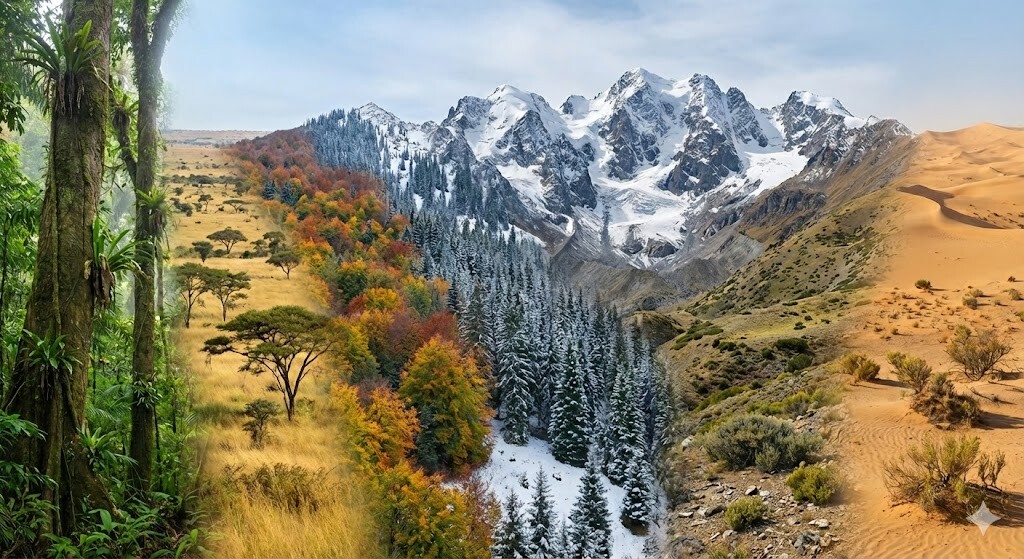
Your Ecological Address
You’re standing somewhere right now. Your phone knows the coordinates — latitude and longitude to six decimal places, accurate to the width of your living room. But what does that spot mean ecologically? What ecoregion are you in? What climate zone shapes the seasons here? What elevation determines whether frost reaches your garden? What slope and aspect determine whether your hillside bakes in afternoon sun or holds morning dew until noon? What birds should be singing outside your window this morning, and what weather should accompany them?
It turns out that everything you need to answer those questions is freely available, queryable from your coordinates alone, and most of it has been sitting there for years. This past week, while building the data architecture for a citizen science ecological monitoring framework, I accidentally assembled something that feels more universally useful: a recipe for computing what I’ve started calling your ecological address.
The weather where you are at
The discovery started with a practical problem. I’m building a framework called SCOPE — Science Community Observatory for Participatory Ecology — that envisions citizen science observers capturing species observations and habitat structure at thousands of locations where no weather station exists. Those observations need environmental context. So I tested the obvious sources: gridded weather products that estimate conditions at any coordinate by interpolating from satellite data and atmospheric models.
At my home in Oregon City, sitting in the Willamette Valley at forty-five meters elevation, the free OpenWeatherMap API reported a temperature within 1.3°F of my calibrated weather station. Good enough. At our site in Bellingham, Washington, the agreement was within 1.7°F. But when I tested the James San Jacinto Mountains Reserve — a UC Natural Reserve at 5,410 feet in the mountains of Southern California, a place I directed for twenty-six years — everything fell apart.
NASA’s POWER reanalysis product, drawing on the same satellite-derived models that feed global weather forecasts, placed the reserve’s grid cell at 983 meters elevation. The actual station sits at 1,649 meters. That 666-meter error — two thousand feet — meant the API was describing conditions on the desert floor, not in the mixed conifer forest on the mountain. It reported a February daily mean temperature of 61°F. Anyone who has spent a February night at the James Reserve knows that 61°F is a fantasy. It’s closer to 37°F, with frost most mornings.
The OpenWeatherMap product fared somewhat better but still inverted the temperature — reporting the mountain as colder than it actually was on a day when the station sat above a valley inversion. The 25-kilometer grid cell was trying to average across three thousand feet of vertical relief, spanning vegetation zones from Sonoran desert scrub to subalpine forest. No single number can represent that gradient.
One product got it right. Daymet, maintained by Oak Ridge National Laboratory, operates on a one-kilometer grid interpolated from actual ground stations. Its grid cell for the James Reserve reported an elevation of 1,760 meters — only 111 meters off, a fifty-fold improvement over NASA POWER. Its February temperatures were realistic: highs in the low forties, lows near freezing. Daymet understood the mountain because its grid was fine enough to see it. But Daymet is a historical archive, updated annually, one to two years behind. It can tell you what February normally looks like at your coordinates. It cannot tell you what’s happening right now.
So I turned to a different question: who has a thermometer on the actual mountain?
The answer came from Weather Underground — not the forecasting website, but the personal weather station network that IBM has been aggregating for years. I typed the James Reserve coordinates into the “nearby stations” API query, expecting to find perhaps one or two instruments in the nearest valley town. Instead, nine stations came back, all in the Idyllwild–Pine Cove community, all between 5,300 and 6,400 feet elevation, all within seven kilometers, all reporting in real time. Davis weather stations, Ambient Weather stations, running on solar panels on back decks and rooftops. The nearest was a Davis unit at 6,365 feet — actually three hundred meters above the reserve — reading 41.7°F at five in the afternoon. A real thermometer on the real mountain, reporting what the satellites could not resolve.
I lived on that mountain for 35 years. I drove through Idyllwild for groceries and mail. Some of those weather station owners were probably my neighbors. And all along, their instruments were doing what a fifty-million-dollar reanalysis grid could not: measuring the weather at the correct elevation.
The same pattern held at all four test sites. Ten stations within two kilometers of my home in Oregon City. Ten near Bellingham. Even Blue Oak Ranch Reserve, on an isolated hillside in the Diablo Range east of San Jose, turned up community stations that bracketed the reserve’s elevation — one a hundred meters below, one a hundred meters above, each within three miles. The community weather station network, deployed by people who simply wanted to know their local conditions, constitutes a denser monitoring network than any government or university has ever built.
What a coordinate knows
With the weather problem solved — or at least, with a clear path forward — I turned to the deeper question: what is this place? Not what’s happening here today, but what kind of place is this ecologically? This is the question that field ecologists spend careers developing intuition for, the knowledge that takes decades of walking the same landscape to accumulate. Can a coordinate answer it?
It can, and with surprising richness.
A Mapbox Terrain-RGB digital elevation model returns your altitude at roughly ten-meter horizontal resolution with sub-meter vertical precision. But elevation alone is only the beginning. By sampling a three-by-three neighborhood of pixels around your coordinate, the tool computes slope and aspect — the steepness and compass orientation of the ground where you’re standing. These are among the most ecologically meaningful variables a coordinate can yield. A south-facing slope at 24 degrees receives fundamentally different solar radiation than a north-facing slope at the same elevation: different soil temperatures, different evaporation rates, different frost regimes, different plant communities. My home at Canemah sits on a 23.8-degree east-facing bluff above the Willamette River — a topographic position that catches morning sun, sheds afternoon heat, and creates a microclimate distinct from the valley floor forty-five meters below.
A Köppen climate classification service maps your coordinates to the global climate zone system that every ecology student learns: Mediterranean warm summer (Csb) for my Oregon Valley site, tropical rainforest (Af) for the La Selva Research Station in Costa Rica. Twenty-eight-kilometer resolution, global coverage, one call.
The EPA’s ArcGIS service returns the Omernik ecoregion classification — four nested levels from continental biome down to vegetation community. My coordinates in Oregon City resolve to Marine West Coast Forest at the broadest scale, narrowing through Willamette Valley at Level III to Prairie Terraces at Level IV. The James Reserve resolves to Southern California Mountains within the Mediterranean California biome — a classification that immediately distinguishes it from the Sonoran desert that the POWER grid cell lumped it with. This is the ecological identity that the grid cell’s elevation error obscured.
The USGS National Land Cover Database adds satellite-derived cover type at thirty-meter resolution — the actual vegetation at the point where you’re standing, not a theoretical classification. Evergreen forest. Deciduous forest. Shrub-scrub. Emergent wetland. Where forest pixels are detected, the USDA Forest Service FIA atlas adds the dominant tree community — Douglas-fir group, Oak/Hickory, Ponderosa Pine — connecting the satellite classification to the trees you’d actually see.
iNaturalist connects the coordinate to the species that have been documented within one kilometer — not just a count, but actual names, observation frequencies, and photographs organized by taxonomic group. Plants, birds, mammals, reptiles, amphibians, insects, fungi, arachnids, mollusks. Query the coordinates near Idyllwild and 909 species come back. The top plant observation is Pringle’s manzanita. Second is Sarcodes sanguinea — the snow plant, that improbable blood-red mycoheterotroph that erupts through duff in montane conifer forests. I wrote my doctoral dissertation on Sarcodes at Cornell in 1983. Forty-three years later, it’s still the second most frequently observed plant within a kilometer of the mountain where I spent my career, showing up unbidden in a database query I ran from a kitchen table in Oregon.
eBird adds a different temporal lens — not what has ever been documented here, but what birders have seen in the last thirty days. Recent sightings and notable species within a widening radius, each linked back to the observer and the checklist. The distinction matters: iNaturalist tells you what can live here; eBird tells you what’s actually present this week. And where eBird depends on human observers venturing out with binoculars, BirdWeather fills the gaps with AI-powered acoustic monitoring — automated listening stations that identify bird species by their vocalizations around the clock. The tool queries nearby BirdWeather stations for the past seven days, returning species detected by sound along with confidence scores and station metadata. Between the two, you get both the birder’s checklist and the acoustic landscape — what’s being seen and what’s being heard.
Layer these together and a bare coordinate becomes something I can only describe as an ecological address. Here is what the tool returns for the James Reserve:
Idyllwild, Riverside County, California (33.8085°N, 116.7761°W) Elevation: 1,638 m (5,374 ft) | Slope: 12.4° | Aspect: 166° S-facing Climate: Csa — Mediterranean, hot summer Ecoregion: Southern California Mountains → Southern California Montane Conifer Forest Land Cover: Evergreen Forest Current conditions: 31°F, 95% humidity (KCAIDYLL45, 3.9 mi) 909 species observed within 1 km across 9 taxonomic groups
That address tells you more about the ecological identity of a place than most field station descriptions provide. And it’s computed automatically, from the coordinate alone, using free data sources queried in parallel and returned in about two seconds.
What this means for anyone
I’ve been building ecological monitoring systems for forty years — datalogging weather stations and LaserDisc viewmaps in the 1980s, robotic cameras and wireless sensors in the 1990s, mesh radio networks and machine learning in the 2000s, landscape-scale instrumentation across three thousand acres in the 2010s. Each generation required more specialized hardware, deeper institutional support, and narrower expertise. Then I retired, came home to a backyard in Oregon, and started over with a portable camera, free APIs, and AI that runs on a laptop. What strikes me about the ecological address is that it requires none of the infrastructure I spent a career building. It requires a coordinate and a web browser.
You can look up your own ecological address right now. The tool is live — click the map, search for a place by name, or let your browser find your current location. It queries the elevation model, the climate classification, the ecoregion service, the land cover database, the nearest weather stations, and the species observations, all in a single pass. Eight cards come back, each summarizing one dimension of the ecological identity of wherever you pointed: your terrain, your climate zone, your ecoregion and biome, your land cover, current weather conditions, biodiversity from iNaturalist, recent bird sightings from eBird, and acoustic bird detections from BirdWeather. Click any card to expand the full dataset — the four-level ecoregion hierarchy, every species name and photograph, the weather station network around you.
Above the cards, a template-driven prose summary weaves the data into natural sentences — what a naturalist would say about your place at a glance. Click “Read More” and a local language model reads the entire joint distribution of data and writes a deeper interpretive narrative: why this assemblage exists here, what the slope and aspect mean for the biota, what the species list reveals about the ecosystem’s character. The ecology emerges not from any single data source but from their combination — fifteen free APIs converging on a single coordinate, interpreted by a model running on a Mac Mini in my office in Oregon.
This is why the ecological address matters beyond the technical framework that motivated it. It’s a way for anyone to understand where they actually live — not just their street address or zip code, but their ecoregion, their biome, their position in the planetary pattern of climate and life. It’s the kind of knowledge that native peoples carried for millennia and passed down through stories, seasonal rounds, and place names that encoded ecological meaning. Modern urban life has largely erased that sense of ecological place. The ecological address doesn’t restore it — nothing digital can replace a lifetime of watching the same landscape — but it opens a door. It gives you a name for where you are and a reason to pay attention.
Try it: [YEA! Your Ecological Address]
The tool works globally — ecoregions from the RESOLVE Terrestrial Ecoregions dataset (Dinerstein et al. 2017), land cover from Esri’s Sentinel-2 10m classification, and modeled weather from Open-Meteo provide ecological context anywhere on Earth. Within the US, additional layers sharpen the picture: four-level Omernik ecoregion hierarchy, NLCD 30-meter land cover, and dense personal weather station coverage from Weather Underground. Click a coordinate in Botswana and the Zambezian Baikiaea woodlands come back with whatever iNaturalist observers have documented; click one in the North Cascades and you get subalpine species assemblages with real-time acoustic bird detections from nearby BirdWeather stations.
The infrastructure already exists. The data are free. The weather stations are on your neighbors’ rooftops. The satellites have been mapping your ecoregion for decades. Your ecological address has been waiting for you to ask.
References
- Dinerstein, E., D. Olson, A. Joshi, C. Vynne, N.D. Burgess, E. Wikramanayake, N. Hahn, S. Palminteri, P. Hedao, R. Noss, M. Hansen, H. Locke, E.C. Ellis, B. Jones, C.V. Barber, R. Hayes, C. Kormos, V. Martin, E. Crist, W. Sechrest, L. Price, J.E.M. Baillie, D. Weeden, K. Suckling, C. Davis, N. Sizer, R. Moore, D. Thau, T. Birch, P. Potapov, S. Turubanova, A. Tyukavina, N. de Souza, L. Pintea, J.C. Brito, O.A. Llewellyn, A.G. Miller, A. Patzelt, S.A. Ghazanfar, J. Timberlake, H. Klöser, Y. Shennan-Farpón, R. Kindt, J.-P.B. Lillesø, P. van Breugel, L. Graudal, M. Voge, K.F. Al-Shammari, and M. Saleem. 2017. “An Ecoregion-Based Approach to Protecting Half the Terrestrial Realm.” BioScience 67(6): 534–545. DOI: https://doi.org/10.1093/biosci/bix014 ↗
- - Hamilton, M.P. (2026). "Ecological Site Characterization from Coordinates." Canemah Nature Laboratory Technical Note CNL-TN-2026-024. ↗
- - Hamilton, M.P. (2026). "Ground-Truthing the Sky: Evaluating Free Weather APIs and Community Station Networks." Canemah Nature Laboratory Technical Note CNL-TN-2026-023. ↗
- - Omernik, J.M. (1995). "Ecoregions: A Spatial Framework for Environmental Management." Lewis Publishers. ↗
- - Olson, D.M. et al. (2001). "Terrestrial Ecoregions of the World: A New Map of Life on Earth." BioScience, 51(11), 933–938. ↗
- - Thornton, M. et al. (2022). "Daymet: Daily Surface Weather Data on a 1-km Grid for North America, Version 4 R1." ORNL DAAC. https://doi.org/10.3334/ORNLDAAC/2129 ↗