
Before They Called It IndieWeb
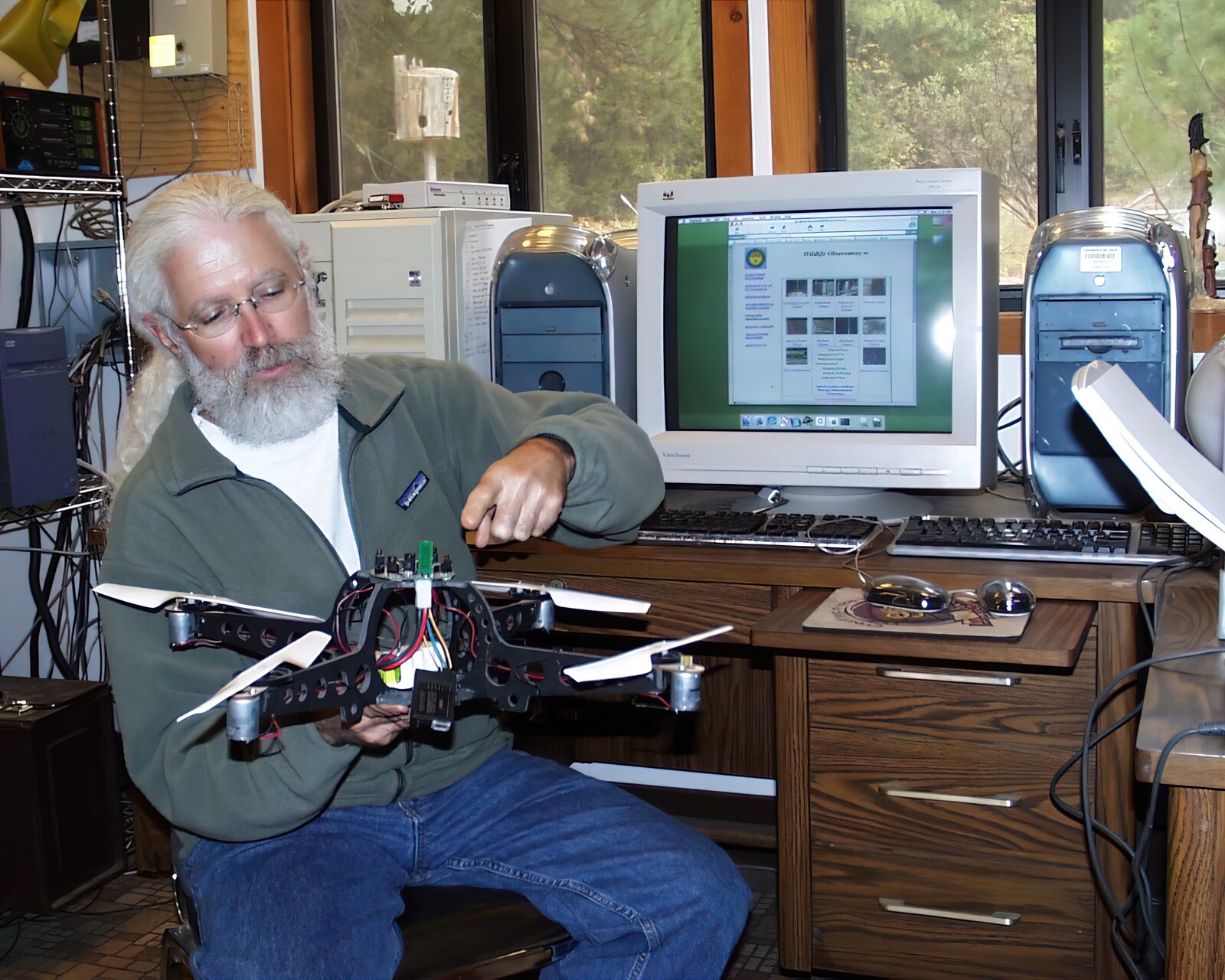
In the photograph, I am holding a Draganflyer—one of the earliest hobbyist quadcopter platforms, imported from Canada before the word “drone” meant anything but bees and Pentagon projects. Behind me, two blue Power Macintosh G3, a beige PC tower, a tangle of cables on a wire shelf. The CRT monitor shows the Wildlife Observatory website. Through the window, pines.
It is 1998. Those machines are running on solar photovoltaics and batteries. The nearest town, Idyllwild, is nine miles down a mountain road. The bandwidth comes through the last pair of twisted copper wire in our fragile underground phone lines, fractional frame relay, one megabit per second—which felt, at the time, like drinking from a firehose.
I did not know the word “IndieWeb.” The movement wouldn’t coalesce for another dozen years. But I was living its principles out of sheer necessity: own your domain, run your own servers, publish to the web you control because there is no other web available when your research station sits inside a national forest and the cloud hasn’t been invented yet.
The James San Jacinto Mountains Reserve had been my home and laboratory for over a decade by then. I’d arrived in the early 1980s as a young ecologist with a fresh Cornell doctorate and a hunch that computers might be useful for understanding ecosystems. The University of California let me run the place, and I ran it like a research vessel—small crew, long voyages, everything jury-rigged from available materials.
The Macroscope was my name for the instrument I was building. Not a microscope, not a telescope, but something that could see across scales: weather stations logging temperature and humidity every fifteen minutes, cameras pointed at bird feeders, GIS layers stacked in PC Arc/Info, phenology plots where we tracked the first bloom of manzanita and the last flight of painted ladies. The idea was to make the mountain legible—to turn a place into data without losing the place.
When the internet arrived, I saw immediately what it meant. The Macroscope didn’t have to stay local. The data, the images, the live feeds could go anywhere. Anyone with a browser could watch the weather change at 5,600 feet in real time.
But getting connected meant solving problems that didn’t have consumer solutions. I negotiated with the phone company for access to underground lines that ran along the road between the Reserve and Idyllwild. My assistants and I learned enough about frame relay to manage the routers ourselves. I acquired jamesreserve.edu—one of the earliest .edu domains—and digitalnaturalist.com for my personal work. I set up the servers in the same office where three of us shared space, and where the only electricity came from panels on the roof of my residence and lead-acid tractor batteries were housed in an outdoor closet.
The Draganflyer in the photograph was the next logical step. If I could put cameras on the ground and cameras on the network, why not cameras in the air? I called the concept “pop-up visual data loggers”—platforms that could capture spatially registered micro-aerial images, geolocated so they could talk to the GIS layers. The idea was to fill in the scale between satellite imagery and ground plots, to see the canopy the way a bird sees it.
The drone experiments didn’t pan out the way I’d hoped. The technology wasn’t ready; the platforms were too unstable, small radio transmitters for video had very short range and low resolution , and I was lucky if the batteries would last 10 minutes. It would take another fifteen years before DJI made the whole thing trivial. But the impulse—instrument the world at every scale, make the data flow, own the infrastructure so you can keep the records—that impulse never went away.
I mention all this because I spent this morning reading about IndieWeb for the first time, following links that Perplexity surfaced, and I kept having the uncanny sensation of finding vocabulary for things I’d been doing without names.
POSSE—Publish on your Own Site, Syndicate Elsewhere. That’s what I did when I cross-posted from digitalnaturalist.com to early aggregator sites and mailing lists.
Webmentions, microformats, the emphasis on durable URLs and data portability. These are formalizations of problems I’d been solving ad hoc since the Clinton administration.
Paul Robert Lloyd’s essay “The web we want” describes personal websites as “spaces of continuity, narrative, and self-determined design.” That’s exactly what I was building in that solar-powered room—not because I had a philosophy about platform capitalism, but because there was no platform. There was just me, the sun, the forest, and whatever I could make work.
The reason this matters now is that the constraints have shifted.
In 1998, the hard part was technical. Could you configure the server? Could you write the HTML? Could you keep the batteries charged and the frame relay link stable? The IndieWeb ethos emerged from people who could answer yes to those questions and who understood that owning the stack meant owning your future.
In 2026, the hard part is no longer technical. I sit down with Claude Opus 4.5 most mornings, and I can describe what I want in plain English—a serialization engine for a novel, a new subdomain for a research project, a database schema for phenology records—and by lunchtime I have working code. Vibe coding, they call it. Describe the behavior, iterate until it feels right, ship.
This should make IndieWeb obsolete. If anyone can spin up a site in an afternoon, what’s special about owning your domain?
But I think the opposite is true. The scarcity has moved. Implementation is cheap now. What remains scarce is attention, care, and long-term stewardship. The IndieWeb question is no longer “Can you build it?” but “Will you maintain it? Will you keep the URLs alive? Will you let the record accumulate into something that matters?”
I can point to digitalnaturalist.com essays from 1998. The domain still resolves. The words are still there. Twenty-seven years of continuity, not because I was particularly virtuous but because I owned the stack and had nowhere else to put the work.
That’s what IndieWeb means to me: not a protocol spec, not a set of microformats, but a commitment to duration. Your website as home, not hotel. Your URLs as long-term identity, not exhaust.
These days I run a different kind of field station. The house in Oregon City has its own small server room—a Mac Mini with a gigabit fiber connection, another machine for computation, the whole thing wired together in ways that would make a real sysadmin wince. The domains have multiplied: coffeewithclaude.com for the essays, canemah.org for the local natural history, hotwater.world for a science fiction project about intelligence and deep time.
The Macroscope is still the organizing concept. EARTH, LIFE, HOME, SELF—four observation domains, nested scales, sensors and databases and narrative all flowing together. The tools are better now. The bandwidth is absurd. The AI can write code faster than I can type comments.
But the core practice is the same one I learned in that solar-powered room with the pines outside the window: own your instruments, own your data, own your narrative. When the platform fails—and platforms always fail—you want to be standing on ground you control.
I didn’t know I was doing IndieWeb in 1998. I was just trying to make a mountain visible to the world, using whatever I could build. It turns out that impulse has a name now, and a community, and a set of principles that have only become more urgent as the tools have become more powerful.
The Draganflyer never flew the way I wanted. But the websites are still up. The records are still accumulating. The work continues.
That’s the whole point.
References
- - IndieWeb. (n.d.). “IndieWeb.” *IndieWeb Wiki*. https://indieweb.org ↗
- - Lloyd, P. R. (2024). “The web we want: A beginner’s guide to the IndieWeb.” *paulrobertlloyd.com*. https://paulrobertlloyd.com/2024/201/s1/peckham_digital ↗
- - James San Jacinto Mountains Reserve. (n.d.). *University of California Natural Reserve System*. https://jamesreserve.edu ↗
- - Hamilton, M. P. (1996–present). “Notebook of a Digital Naturalist.” *digitalnaturalist.com*. https://digitalnaturalist.com ↗