Root Systems: An Evening of Convergent Paths at Lewis and Clark
Lewis and Clark College holds more of my history than I expected to encounter Wednesday evening. My daughter Caitlin earned her degree here, graduating in 2008. I've walked this campus before, sat in this very building when it was still called Templeton Campus Center—before the 2023 renovation transformed it into the Stephanie Fowler Student Center. The bones are the same; the skin is new. What I didn't know, until a hallway conversation during the break revealed it, was that this campus held other threads connecting to my own formation as a scientist.
I'd come for a Cornell alumni event—a climatologist named Toby Ault, touring the West Coast to promote something called Project Westwind. The program description mentioned climate science, citizen engagement, STEM education. Standard academic outreach. I expected a pleasant evening with fellow alumni, some conversation about the state of environmental research.
What I got was something stranger and more resonant: a collision of intellectual lineages I hadn't known were intertwined.
The Presentation
Professor Ault opened with biography. A Watson Fellowship that sent him retracing Darwin's footsteps through South America. El Niño flooding in Uruguay. Drought in the Australian Outback, a rancher selling off his herd. The origin story of a climate scientist—how visceral encounters with weather variability set the course of a career.
The delivery was scattered, extemporaneous, the kind of free-form academic ramble that works in seminar rooms but struggles in public venues. Static PowerPoint slides that rarely synchronized with his verbal narrative. The room was forgiving—mostly mid-career professionals and retirees, tolerant of the talking-head approach. A younger audience would have checked their phones.
But then something shifted. Ault started talking about his K-12 outreach work in New York. Middle school kids with terrariums. Small closed systems where they could manipulate inputs—add plants, change light conditions, seal the container—and watch what happened to CO2 levels in real time. Low-cost sensors measuring temperature, humidity, carbon dioxide, particulates. The invisible made visible. Kids watching the carbon cycle respond to their interventions.
He'd collaborated with a company to build a portable sensing device—shoebox-sized, battery-powered, with a touchscreen dashboard and integrated sensors. Only four prototypes existed, built through the frustrations of offshore manufacturing. On this very tour, he'd strapped one to his roof rack and driven from San Diego to Portland, logging air quality across 1,200 miles of California and Oregon. Unable to verify the device was even working, watching the battery gauge as his only telemetry, hoping the data was accumulating.
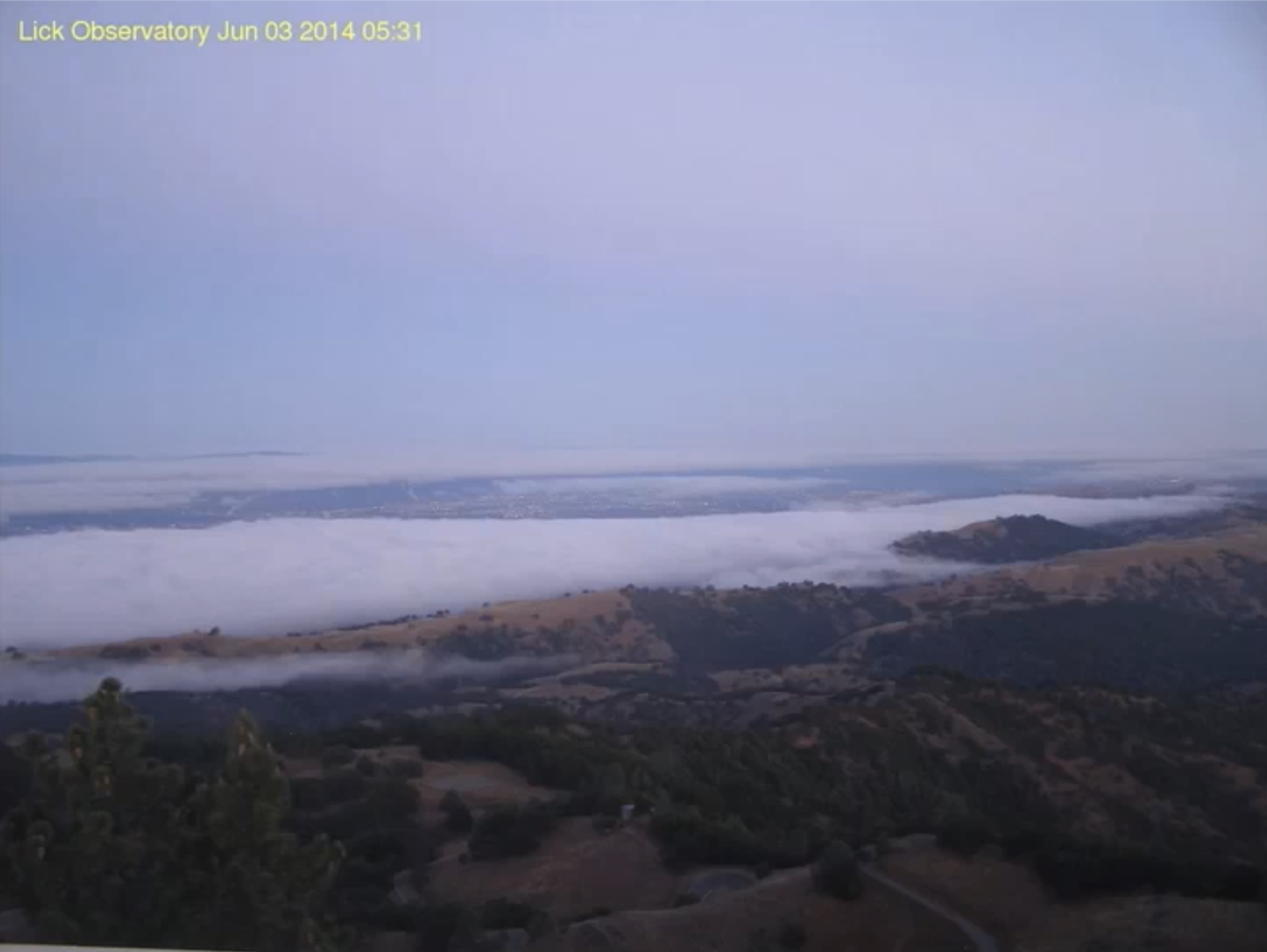
When he showed the visualization—a color-coded trace of his route, green shifting to red through the urban corridors of Los Angeles, the Central Valley, the Bay Area, then a vivid crimson band where tule fog had trapped particulates across the San Joaquin—the room went quiet. The scattered narrative had found its center. The data was doing what data does when properly rendered: telling a story that words alone cannot convey.
Later, he played us a trick. Two time series of El Niño and La Niña oscillations—one observed data, one model output. Visually indistinguishable. Then he converted them to sound, and the difference was immediate. The observed climate had texture, organic irregularity. The model was too smooth, too regular. The ear detected what the eye had missed.
These were sophisticated pedagogical moves. Sonification. Real-time feedback loops. Multi-modal data representation. Someone had thought carefully about how people learn to see the invisible.
During the Q&A, I asked about the cost of his sensor system and whether he'd explored off-the-shelf platforms like the BirdWeather PUC. The answers were vague—I suspect the prototypes ran into the thousands, and the commodity landscape wasn't something he'd deeply engaged. When I tried to press on scalability, on how citizen science networks might leverage affordable hardware that already exists, I sensed he was still working out those questions himself.
The Connections
I'd reached out to Ault by email before the event, introducing myself—thirty-six years directing a UC field station, co-PI on the NSF Center for Embedded Networked Sensing, now working on urban forest monitoring in retirement. He'd written back warmly, suggested we might meet before his talk. But when I arrived early, he was hunched over his laptop troubleshooting some data issue, distracted by the accumulated travel complications of a West Coast tour. We shook hands, exchanged brief greetings, and he returned to his screen. The connection I'd hoped for didn't materialize.
Instead, I found myself talking with Toby's sister, who ran an outdoor recreation program at Lewis and Clark. Then an older couple appeared, and I could see from their name tags they were Aults—his parents. During the break, I stepped into the hallway and struck up a conversation with the father.
Kip Ault had taught science education at Lewis and Clark for twenty-four years. The same Lewis and Clark where my daughter had earned her degree. And Kip had earned his own doctorate at Cornell in 1980—three years before I finished mine.
The threads multiplied rapidly. Kip and my first wife Ann had both studied under Vern Rockcastle, the legendary "Doc Rock" who taught generations of Cornell students to find science lessons in cricket chirps and chalk squeaks and the rings of wooden baseball bats. Rockcastle, who wrote the Cornell Science Leaflets for fifteen years, who believed everyone could learn to see the natural world scientifically if shown the right doorways.
Standing in that hallway, trading Cornell memories with a man I'd never met, the root system revealed itself. Rockcastle teaching Kip and Ann in the late 1970s. Kip building a career at Lewis and Clark around making science accessible to teachers. Kip and Toby publishing together in 2009—retracing Darwin's fossil-hunting through Patagonia, father and son following the same intellectual thread. And now Toby, presenting on the campus where his father had taught and my daughter had studied, handing middle schoolers CO2 sensors and terrariums.
The science education lineage was literal, not just institutional. Three generations. And I'd been adjacent to it the whole time without knowing—but it was the father, not the son, who opened the door.
The Crisis
What brought Ault west wasn't celebration. It was survival strategy.
Project Westwind is an attempt to build resilience for climate science at a moment when the federal infrastructure that supports it is being systematically dismantled. NOAA has lost hundreds of staff. The National Weather Service has suspended weather balloon launches at multiple sites due to staffing shortages. In July, a flash flood killed eighty-nine people in Texas Hill Country; the responsible forecast office had lost twenty-two percent of its staff to DOGE cuts.
The insurance industry—which has enormous financial stakes in accurate climate risk assessment—is now partnering directly with academic researchers like Ault because they can't rely on federal data pipelines remaining functional. Project Westwind seeks to build a broader coalition: industry partners, K-12 educators, citizen scientists, university researchers. Multiple constituencies with multiple reasons to keep climate observation alive.
This is what resilience looks like when institutions fail. Distributed networks. Redundant pathways. Stakeholders with skin in the game who don't need federal permission to keep observing.
The Evolution of Knowing
Kevin Kelly wrote that science will continue to surprise us with what it discovers, then astound us by devising new methods to surprise us. "What evolves," he observed, "is less the body of what we know and more the nature of our knowing."
I've been thinking about this formulation since Wednesday evening. Ault and I are working the same problem—how to make ecological observation scalable, affordable, legible to non-specialists—but from different positions in time, with different tools, at different scales.
In January 1984, I was twenty-eight years old and wrote a proposal for something called the Electronic Museum Institute. Data Clusters that would monitor temperature gradients, precipitation, wind, humidity, wildlife vocalizations, and plant phenology. Field Loggers that would record microtopographic features, stereoscopic video, distance measurements, and supplemental notes. Laser optical discs storing 54,000 frames each. An HP 9000 workstation processing the streams. Expert systems organizing ecological relationships into navigable knowledge.
The hardware I specified doesn't exist anymore. Laser discs are museum pieces. The HP 9000 is a footnote. But the architecture—distributed sensing, multi-modal capture, knowledge graphs linking species and features and processes—that architecture persists. The tools changed; the nature of the knowing evolved; the core recognition remained stable.
Today's version of that proposal sits on my laptop as a design document called EcoSLAM PADD. Portable Assessment and Data Device. A BirdWeather PUC for acoustic monitoring and environmental sensing. A ZED stereo camera for depth mapping. An Insta360 for spherical context. An iPad Pro with LiDAR for millimeter-precision scanning. All of it streaming to a Jetson edge computer that fuses the data streams and runs AI inference in real time.
Core components cost around a thousand dollars. The full research platform, maybe three thousand. Off-the-shelf hardware. Open-source software. Deployable by a solo researcher in the field.
This isn't a boast. It's an existence proof. The commodity hardware for distributed ecological sensing already exists. The question isn't whether we can afford to instrument landscapes—we can, at scales that would have seemed fantastical when I was hand-wiring thermistor arrays in the 1980s. The question is whether we can build the social and institutional infrastructure to make that instrumentation meaningful.
Offered Hands
I left Lewis and Clark Wednesday night with complicated feelings. Admiration for what Ault is attempting. Empathy for the institutional headwinds he faces. Recognition—almost vertiginous—of how tightly wound our intellectual communities actually are, how many hidden connections link people who've never met.
And something else. A bittersweet awareness of paths that almost crossed but didn't.
I'd reached out before the event, shared my background, hoped to compare notes. The connection didn't happen—not with Toby, anyway. He had a presentation to troubleshoot, a tour to manage, the accumulated friction of canceled flights and prototype devices lashed to roof racks. The door that opened was with his father, out in the hallway, trading memories of a professor who taught us both to find science in everyday things.
I spent thirty-six years at a UC field station building the systems I'd imagined in 1984. Then I retired, and the institution moved on. The work continues at a smaller scale now—Canemah Nature Laboratory, a backyard observatory, the Macroscope architecture I keep elaborating. No NSF grants. No institutional platform. Just a retired ecologist with time, tools, and forty years of accumulated understanding about how to make ecological processes visible.
Toby has the platform I no longer have. I have operational systems he's still prototyping. Neither of us can do alone what might be possible together.
Project Westwind is looking for partners. Industry collaborators. Educational networks. Citizen science infrastructure. The architecture Ault is reaching toward already exists in working form, deployed at multiple sites, documented in technical notes, ready to be adapted and scaled.
Maybe the connection will still happen. Maybe this essay finds its way to someone who can bridge the gap. Or maybe we remain parallel lines, close but never intersecting, working the same problems from different positions in time.
But the root system is real. Rockcastle taught his students to find science lessons in everyday things. Kip spent his career at Lewis and Clark making those lessons accessible to teachers. Toby is now handing sensors to middle schoolers and driving transects through tule fog. The lineage continues, whether or not any individual thread connects to it.
What evolves is less the body of what we know and more the nature of our knowing. Wednesday evening, in a building layered with personal history I hadn't fully recognized, I watched that evolution in real time—and wondered what might grow if the root systems finally connected above ground.
References
- - Hamilton, M.P. (2025). "Electronic Museum Institute: A Historical Reference Document." Canemah Nature Laboratory Technical Note CNL-TN-2025-003. https://canemah.org/archive/document.php?id=CNL-TN-2025-003 ↗
- - Cornell University. "Toby R. Ault." Department of Earth and Atmospheric Sciences Faculty Directory. https://www.eas.cornell.edu/faculty-directory/toby-r-ault ↗
- - Lewis & Clark College. "Charles (Kip) Ault." Graduate School of Education and Counseling Faculty Profile. https://graduate.lclark.edu/live/profiles/1883-charles-kip-ault ↗
- - Cornell University (2015). "Cornell remembers science education pioneer 'Doc Rock'." College of Agriculture and Life Sciences News. https://cals.cornell.edu/news/cornell-remembers-science-education-pioneer-doc-rock ↗
- - Kelly, K. (2010). *What Technology Wants*. Viking Press. ↗
- - Ault, T.R. & Ault, C.R., Jr. (2009). "On the Trail of Darwin's Megabeasts." *American Paleontologist*, 17(1), 16-19.