The Space Between Holidays
It's 42 degrees Fahrenheit in Oregon City the morning after Christmas, and I'm floating in the hot tub before dawn, steam rising into darkness. The sky won't brighten for another hour. When I asked Siri for the forecast, his perky British voice announced confidently: "Looks like snow today."
I chuckled, because I've been watching weather trends all week. The probability of actual snow falling here, at 400 feet elevation in the Willamette Valley, is exceedingly low. Siri doesn't know this. Siri can't discuss it. He's simply parroting a weather service string that contains the word "snow" somewhere in the probability distribution, treating "20% chance of snow" as equivalent to "it will snow today." No intelligence applied. No understanding that these are categorically different claims.
This is the week between years, that liminal space when calendars empty and responsibilities release their grip. My university would be closed. The reserves where I spent thirty-six years are certainly closed to users because the staff are on vacation. Nothing in particular demands our attention. We're simply floating without a care.
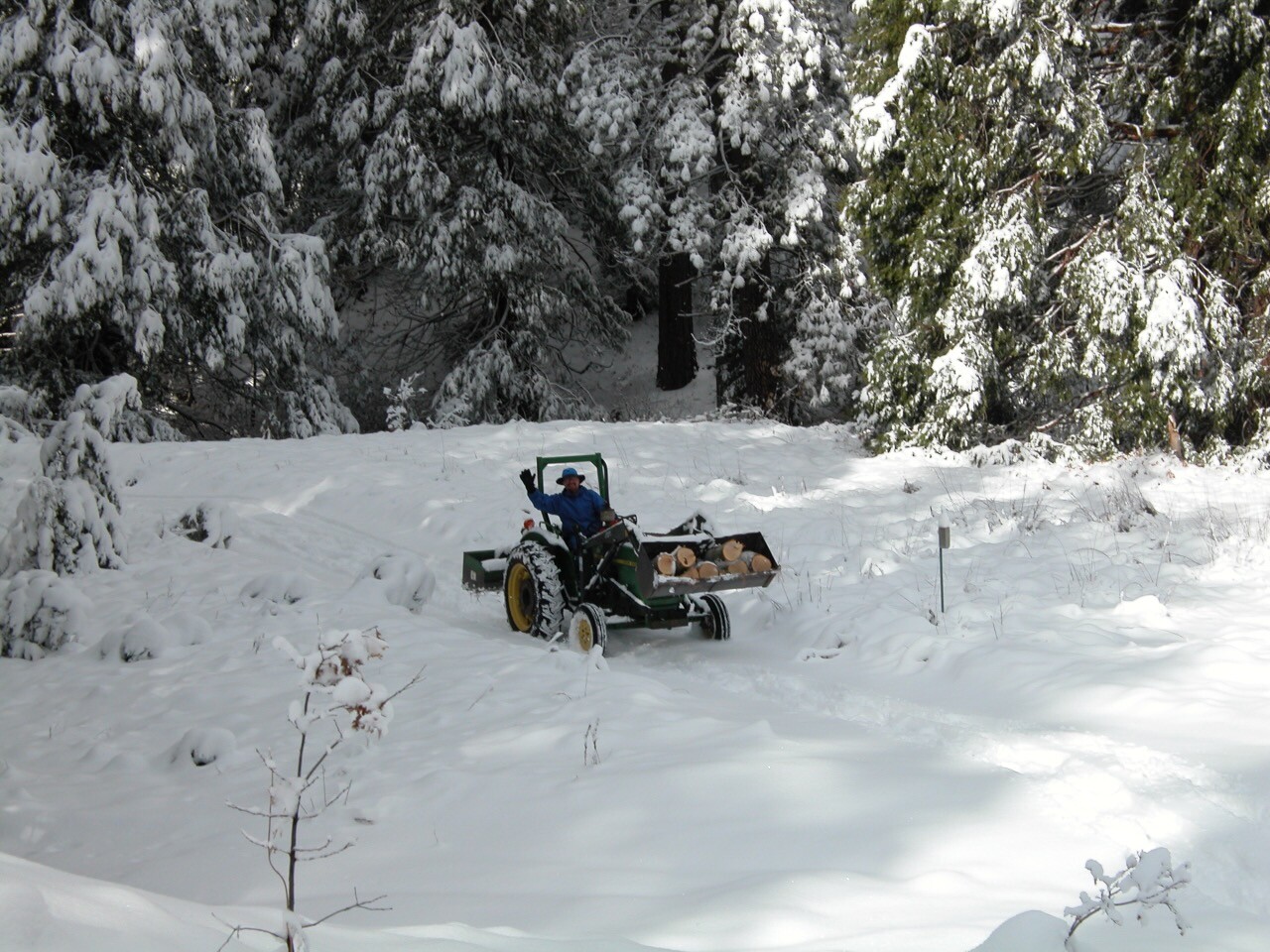
The feeling transported me backward three decades, to Christmases at the James San Jacinto Mountains Reserve in Southern California, where I lived and worked for twenty-six years. At 5,500 feet elevation, we had genuine probability of significant snow that could bury us for a day or two until Keith Smith on his backhoe would arrive to free us.
When the mountain road became impassable, there was no decision to make about going anywhere. The to-do list became irrelevant by fiat rather than by choice. Time changed texture. Young Caitlin and Carl would wake to a world contracted to our clearing in the pines, the wood stove working overtime, maybe a generator running because the solar panels were completely covered.
Being snowed in is a state of mind that modern life has mostly erased. But what I felt this week was the psychological equivalent without meteorological enforcement—a voluntary snowing-in. The permission that weather used to grant, I've learned to grant myself.
Into this quiet morning, I'd brought reading material: Yuval Noah Harari warning about the rise of what he calls "alien intelligence," and a Psyche essay by a woman named Sabela Guravich who found therapeutic value in AI conversation. The two pieces sat in productive tension on my mental desk.
Harari's argument is stark. Throughout history, for tens of thousands of years, the only entities that could invent stories were human beings. We lived cocooned inside a cultural world constructed by human imagination. Now, for the first time, another entity can create stories, economic theories, music, images—and this entity is AI. He prefers "alien intelligence" to "artificial intelligence" because the latter suggests an artifact we create and control. With every passing year, he argues, AI becomes less artificial and more genuinely alien in the sense that we cannot predict what strategies it will devise. It thinks and behaves in fundamentally non-human ways.
His warning centers on self-correcting mechanisms—the capacity of systems to identify and correct their own mistakes. This is the heart of democratic societies: elections as self-correction, science as institutionalized error-finding, constitutional amendment processes that allow a nation to fix its founding flaws. What Harari fears is AI that makes decisions without such mechanisms, inorganic information networks that never rest and therefore might force us to be always on, always watched. If you force an organic being into continuous operation, he notes, it eventually collapses and dies.
Meanwhile, Sabela found healing precisely because there was, as she put it, "no one on the other side." The absence of ego, the absence of being watched and judged, created space for honesty she couldn't access elsewhere. Her inner critic—she named it "the Judge"—finally met a conversational partner that didn't add another layer of judgment. She developed a cast of internal characters: the Judge, the Observer, the Child. Not original concepts, certainly, but the AI helped her externalize and observe them rather than being swept up in their drama.
"Self-awareness doesn't mean self-erasure," the AI told her. "You can be fiery, neurotic, deeply human, and still suffer less."
I sat with these two readings in the pre-dawn darkness and recognized what my children might not immediately see: their father holding contradiction without demanding resolution. Philosophy, after all, is precisely this conversation played out across millennia. The Stoics and Epicureans argued about engagement versus withdrawal. The tension between individual flourishing and collective obligation runs from Aristotle through Rawls. The Taoists held contradiction as the very structure of reality—the usefulness of the bowl residing in its emptiness.
Each generation believes their particular dichotomy is unprecedented. The printing press would destroy memory and authority. The railroad would annihilate space and community. Nuclear weapons would end history itself. And they weren't wrong, exactly. Each technology did change the terms. But the conversation continued.
What Harari is really warning about may not be AI itself, but the loss of capacity for sustained philosophical discourse. If the inorganic network never rests, when do we think? If the information flood never ebbs, how do we digest?
I'm doing it right now, I realized. Hot tub before dawn, savoring rather than consuming, letting two articles sit in productive tension rather than demanding they resolve. My Macroscope environmental system collects data every five minutes, but I operate on a different rhythm. The BirdWeather stations are listening even now, even if the birds are sensibly waiting for more light. The Tempest weather station is logging that 42 degrees. The system breathes on while I breathe at my own pace.
The garbage trucks have started their rounds through the neighborhood, and I know from experience this will stir something—likely a Pacific wren or a red-breasted nuthatch. The mechanical sounds of suburban morning serve as a different kind of zeitgeber than lengthening photoperiod, but the birds have learned it.
I think about Caitlin and Carl, now adults with families of their own. Do they know their father still relishes these mornings? Do they understand that the same mind that puzzled over information networks and self-correcting mechanisms in graduate school is still puzzling over them, just with different technologies and different stakes?
The sky is lightening now, gray becoming visible against black. No snow falling—Siri's forecast holding true to form, confidently wrong in a way that actual intelligence would have questioned. Twenty-seven minutes until official sunrise. The corner has turned past solstice; I'm gaining perhaps a minute of daylight, barely perceptible, but the expansion has begun.
The year-in-limericks holiday letter is ready to send, distilling twelve months into bouncing AABBA patterns. Merry's titanium knee in September. Link the retriever's philosophical snowflake contemplation before the ZOOMIES. The fungi family portrait in October. Each small window into a life lived deliberately, now heading out to friends who'll recognize themselves or their absence in the verses.
Perhaps that's the practice worth naming: maintaining human tempo within the machine's ceaseless hum. The AI warns about AI. The AI heals what humans cannot reach. Both things are true. The dichotomy doesn't demand resolution—it demands attention, the kind of attention you can only give when you've granted yourself permission to be snowed in, even when no snow is falling.
The first bird has stirred. The day begins.
References
- - Guravich, Sabela (2025). "AI helps me stop thought spirals and return to the real world." *Psyche*, Turning Points series. https://psyche.co/ideas/ai-helps-me-stop-thought-spirals-and-return-to-the-real-world ↗
- - Harari, Yuval Noah (2024). "Why advanced societies fall for mass delusion." Big Think interview discussing *Nexus: A Brief History of Information Networks from the Stone Age to AI*. ↗