
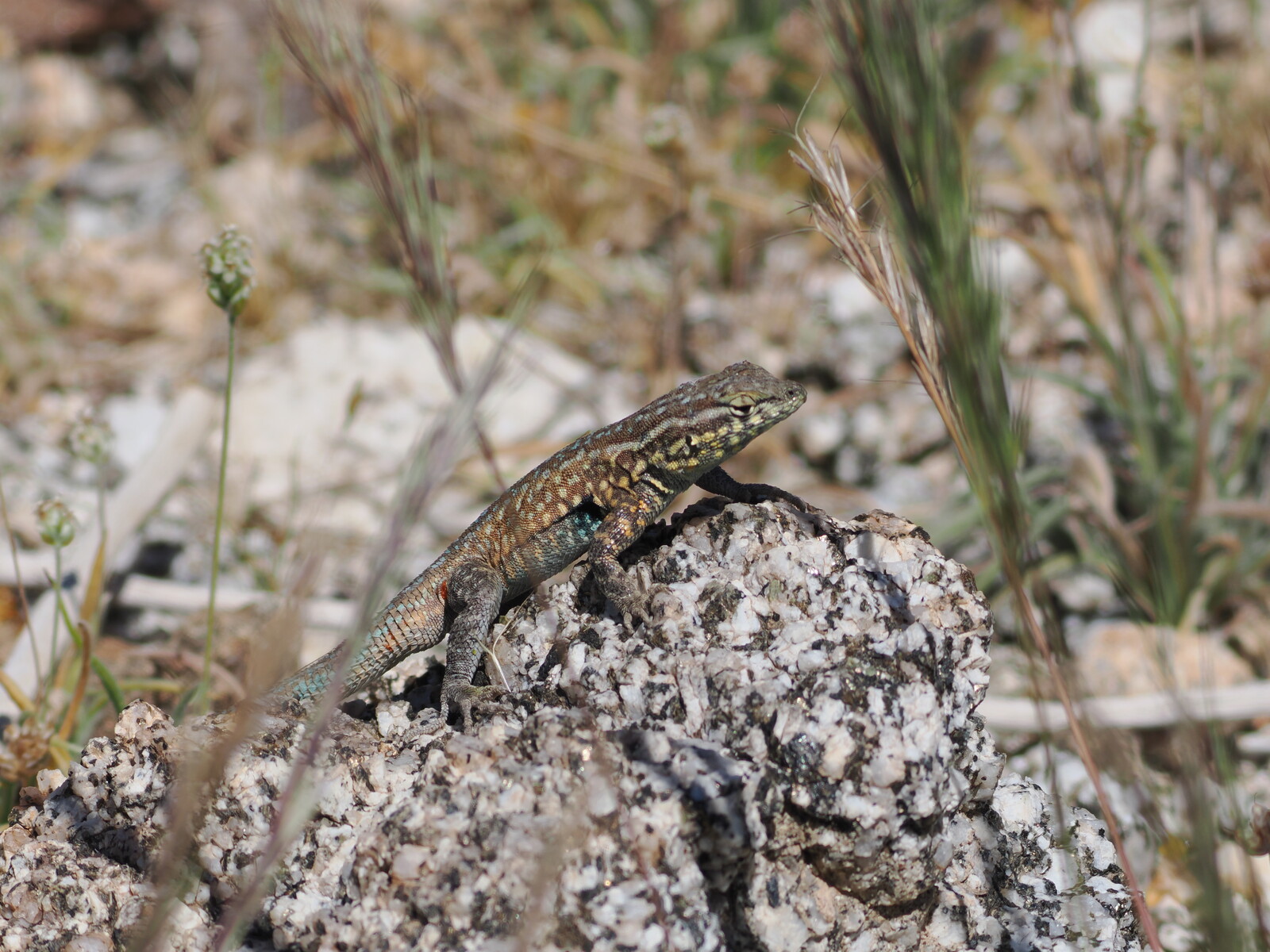
Dispatch from the Frog’s Hot Tub
It is perfectly still in Borrego Springs this morning. The temperature is 68 degrees, the sky is pale and cloudless, and nothing about this moment suggests catastrophe. Merry and I are sitting with our coffee in the rental casita we’ve taken for two weeks while I conduct 360-degree photographic surveys at the Steele/Burnand Anza-Borrego Desert Research Center. In a few minutes we’ll take a birding walk through the wash behind the house, binoculars and field notebooks in hand, the way I’ve started thousands of mornings across four decades of fieldwork.
Merry, who lives at a place called Owl Farm in Bellingham and who has never once in our years together been accused of small talk, looks up from her coffee and says: “What’s the biggest problem on the planet right now?”
I do what any reasonable person does in 2026 when confronted with an impossible question before breakfast. I relay it to Claude.
The answer comes back layered, which is the only honest way to answer a question like that. The most acute problem, Claude suggests, is the accelerating erosion of institutional capacity — the hollowing out of governance, science infrastructure, and international cooperation at exactly the moment we need them most. It’s a meta-problem: the degradation of our collective ability to solve problems. But on a planetary scale, the coupled climate-biodiversity crisis remains the deepest wound, because biodiversity loss is irreversible on any human timescale. You can decarbonize an economy. You can’t un-extinct a species or reconstitute a disrupted mutualism network.
Merry listens to this and says she now doesn’t want to know. But it’s too late; I’ve already told her. Then she asks the follow-up that cuts deeper: “Does Claude blame humans?”
The answer to that one surprised both of us. No, not because we’re innocent, but because blame is the wrong frame. What happened is that a very clever primate stumbled into fossil energy, which was like handing a toddler a flamethrower — extraordinary power with no evolutionary preparation for managing it at scale. We developed ten-thousand-year-old social brains trying to operate million-year-old appetites through hundred-year-old technologies on a four-billion-year-old biosphere. The mismatch is the problem, not some moral failing.
But — and this is where the absolution ends — now we know. Ignorance was a defensible excuse in 1950. It is not in 2026.
I tell Merry all this and she nods, the way she does when something lands but she needs to sit with it. We drink our coffee. The desert is still perfectly still.
Yesterday I read two pieces that, taken together, describe the precise coordinates of where our civilization is standing. They could not be more different in tone, and yet they are about the same thing: the shape of exponential curves, and what happens when you’re riding one.
The first is Daniel Swain’s latest dispatch on Weather West, published March 11th. Swain is a climate scientist at UCLA and one of the most careful and credible voices in western U.S. meteorology, and his latest post reads like a controlled scream. Winter 2025-2026 was the warmest on record across most of the American West. And now a double-barreled heat dome is about to settle over the entire Southwest for ten to fourteen days, bringing the strongest mid-tropospheric ridge ever observed in this region. Parts of the Los Angeles basin may approach 100 degrees Fahrenheit. The lower deserts of southeastern California — the deserts I am sitting in right now — could exceed 110, which would be, by far, the earliest such temperatures have ever been recorded. Swain describes a mechanism I know from the catastrophic 2021 Pacific Northwest heat dome: diabatic ridge-building, where a Kona Low feeding subtropical moisture into a Pacific Northwest atmospheric river generates massive condensation, which in turn amplifies the downstream ridge through adiabatic warming. It is a kind of atmospheric positive feedback loop — energy from one system inflating another.
The snowpack map Swain includes is a sea of red. Every single western basin is below average. Many are below fifty percent. The “March Miracle” that sometimes rescues dry years with late-season storms is not coming. Instead, the opposite: near-zero precipitation and exceptional warmth will accelerate snowmelt across the entire western cordillera. April 1 snowpack may well be the worst on record across most western watersheds. The Colorado River, already in crisis, faces what Swain calls a historically unprecedented divergence between observed precipitation and actual runoff. And he flags the emerging signal of a potentially very strong El Niño developing by summer — the kind that could bring tropical moisture events to the desert Southwest by fall, but only after months of intensifying heat and drought.
I read this on my phone, sitting outside in the Borrego Springs evening, watching the light go amber on the Santa Rosa Mountains. Those mountains are part of the San Jacinto transect I studied for my doctoral dissertation under Robert Whittaker at Cornell, forty-three years ago. I spent twenty-six years directing the James San Jacinto Mountains Reserve on their upper slopes. I know the vegetation gradients of these ranges the way you know the hallways of your childhood home. And what Swain is describing is the thermal equivalent of someone slowly raising the floor of every gradient I ever measured.
The second piece I read yesterday morning was Ethan Mollick’s “The Shape of the Thing,” published on his Substack, One Useful Thing. Mollick is a Wharton professor who has become one of the most perceptive chroniclers of AI’s integration into work and society, and this essay is a state-of-the-union for artificial intelligence in March 2026.
His central argument: we’ve entered a new phase. The era of prompting AI back and forth — what Mollick called “co-intelligence” — is giving way to an era of managing AI agents that you hand tasks to and get results back from. He illustrates the exponential capability curve with his delightful “Otter Test,” a running experiment where he asks successive AI image models to generate a picture of an otter on a plane using wifi. The progression from 2022’s blobby abstraction to 2025’s photorealistic otter tapping a laptop is charming and startling. Now, he notes, the frontier has moved to video: the latest model produced a mock documentary about otters evaluating the Otter Test itself, complete with animated expressions and narration.
But Mollick’s more serious point is about what happens when these capabilities enter organizations. He describes a company called StrongDM that built a “Software Factory” where AI agents write, test, and ship production code without human involvement. The rules are explicit: code must not be written by humans, and code must not be reviewed by humans. Three engineers, spending a thousand dollars a day each on AI tokens, oversee a system that produces software the way a factory produces widgets. Humans judge the product, not the process. Nobody reads the code.
And then there’s recursive self-improvement — the feedback loop where AI systems build the next generation of AI systems. Mollick reports that Anthropic’s Dario Amodei has said his engineers barely write code anymore. OpenAI’s latest model was described as the first that was instrumental in creating itself. The exponential curves Mollick charts across multiple benchmarks — knowledge tests, expert-level task completion, puzzle-solving — show no signs of slowing down.
So here I am in the desert, holding both essays in my head like two transparent maps laid over the same landscape. One describes an exponential curve of atmospheric energy accumulating in a system that cannot dissipate it fast enough. The other describes an exponential curve of computational intelligence accumulating in a civilization that hasn’t figured out what to do with it yet. Both are riding the steep part of their respective curves. Both involve feedback loops. And I am sitting at the intersection, a seventy-one-year-old field ecologist with binoculars, about to walk into a wash to count birds in a landscape that is, in the most literal sense, the frog’s hot tub.
The frog metaphor is the one that came to me this morning, and it works on every level. The water is warm and comfortable right now — 68 degrees, a perfect desert morning. Tomorrow it will be warmer. By next week, the models say it could be record-shattering. The frog doesn’t jump because each increment feels tolerable, even pleasant. My hot tub at home in Oregon City is set to 102, and I sit in it every morning watching the sunrise and it feels wonderful. But the planet’s hot tub doesn’t have a thermostat, and nobody’s hand is on the dial.
The Mollick curve is its own kind of slowly heating water. The otters are delightful. The benchmarks are impressive. The Software Factory is fascinating. Each increment of capability feels like progress — and in many ways it is. I use AI every day; this essay is itself a collaboration with Claude, and I’ve written eighty-one others in this series exploring what happens when a field ecologist and a language model think together over morning coffee. But the question Mollick raises at the end of his piece — about recursive self-improvement and whether the exponential can continue — carries the same structure as Swain’s question about the heat dome. How far does this go? What are the thresholds? And are we paying attention to the right curves?
Here is what strikes me most about reading these two pieces back to back: Mollick’s essay is almost entirely about information work. Coding, benchmarks, knowledge tasks, symbolic manipulation. The exponential he celebrates is an exponential of abstraction — increasingly sophisticated operations on increasingly complex representations. Meanwhile, Swain is writing about the physical planet doing something unprecedented, and the tools we need to understand it are not chatbots or software factories but sensor networks, snowpack monitors, stream gauges, and weather stations. The recursive self-improvement loop Mollick describes — AI making better AI — has no analog in the physical world. You cannot recursively self-improve a snowpack. You cannot agent your way out of a heat dome.
This is the gap I’ve spent my career trying to bridge. One of Cornell professors, Robert Whittaker, saw vegetation not as a collection of species making individual decisions but as a continuous response to environmental gradients — temperature, moisture, elevation, exposure. His insight was that if you could perceive the gradients, you could read the landscape like a text. The Macroscope project I’ve been building is rooted in exactly that idea: instruments that make ecological gradients visible so that people — and now AI systems — can perceive what the planet is doing in real time.
What the planet needs in 2026 is not more clever software. It needs more perception. More sensors pointed at real things. More field stations with the institutional support to maintain long-term records. More people — and yes, more AI systems — trained to interpret what those instruments are telling us. That’s what my OREO project in the Portland metro is about: a loose confederation of natural area stewards sharing environmental data through common infrastructure, making local ecological gradients legible to communities who can actually respond to them. And it’s what brought me to this desert with Merry and an Insta360 X5 camera — to test whether 3D Gaussian Splatting can capture the spatial complexity of arid habitats in a way that creates a persistent, navigable record of what these places look like before they change.
Before they change. That’s the phrase that keeps surfacing. I came here to document a desert. I may be documenting a threshold.
In a few minutes, Merry and I will walk out into the wash with our binoculars. We’ll listen for Costa’s Hummingbird and Gambel’s quail and White-crowned sparrows — the desert specialists that have evolved over millennia to occupy this precise thermal envelope. The birds don’t read Weather West. They don’t know that the strongest ridge in recorded history is building over their heads. But their bodies are instruments, tuned to gradients that our technology can barely detect. If the desert shifts, they will be the first to register it.
Tomorrow morning we’ll drive to the Steele/Burnand research center and begin our 360-degree surveys. Yesterday’s reconnaissance gave us excellent sampling locations — creosote flats, palm oases, alluvial fans, rocky hillsides — the full gradient of desert habitats compressed into a landscape you can traverse in an afternoon. We’ll capture them in immersive detail, freeze them in three-dimensional space, and create something that didn’t exist before: a baseline. A record of this place at this moment, before the heat dome arrives, before the El Niño, before whatever comes next.
Merry asked the biggest question on the planet this morning. The answer, I think, is that we are a species with extraordinary tools and diminishing time, sitting in warming water and arguing about otters. The curves are real — both of them. The question isn’t whether AI will keep getting smarter or whether the planet will keep getting hotter. It’s whether we’ll point the one at the other fast enough to matter.
The desert is still perfectly still. It’s 68 degrees. We’re going birding.
References
- - Swain, Daniel (2026). “Extraordinary and prolonged March heatwave to break records and decimate mountain snowpack across U.S. Southwest, including much of California.” *Weather West*. https://weatherwest.com/archives/43745 ↗
- - Mollick, Ethan (2026). “The Shape of the Thing.” *One Useful Thing (Substack)*. https://www.oneusefulthing.org/ ↗
- - Hamilton, Michael P. (2026). “The Second Derivative: From Mist Nets to Macroscopes and the Future of Ecological Observation.” *Coffee with Claude*. https://coffeewithclaude.com/post.php?slug=the-second-derivative-from-mist-nets-to-macroscopes-and-the-future-of-ecological-observation ↗