
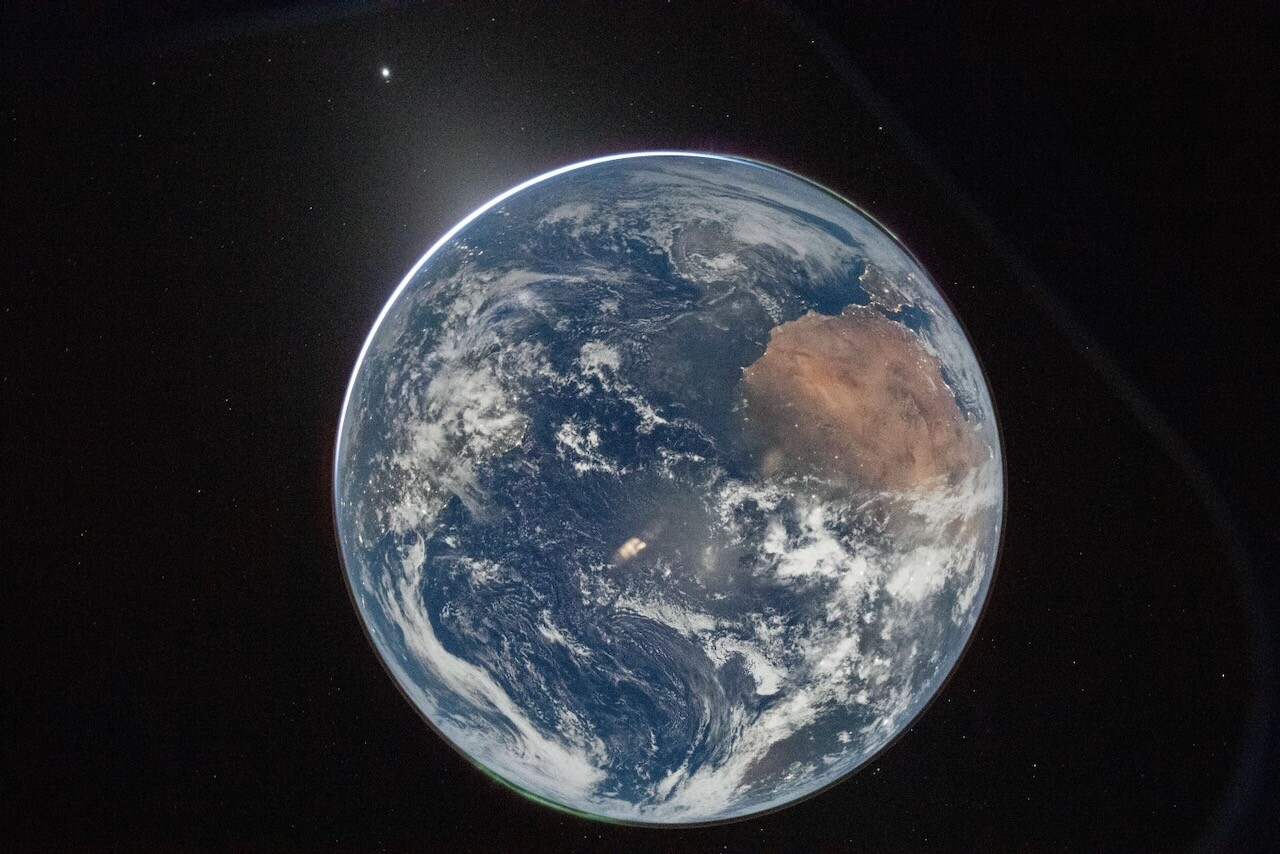
Looking Home from Orion
Field Report: The Third Planet from Sol. Quantum Aperture Probe 1447-Rho, Cethren Stellar Diaspora Mapping Initiative. Transmission follows.
Probe 1447-Rho has opened a quantum aperture into the stellar system designated Sol — an ordinary yellow star in the outer reaches of the galaxy's spiral arm. Eight planets orbit it. This report concerns the third body from the primary, which we designate Sol-3. The temporal window places this observation well beyond the projected dispersal event. What follows describes Sol-3 as it exists in that future state.
Physical Parameters
Sol-3 is a rocky world orbiting within the liquid-water stability zone. A single natural satellite of unusual relative mass maintains axial tilt stability through gravitational coupling, producing predictable seasonal variation. Rotational period is short — roughly one-thousandth of its orbital period — creating rapid day-night cycling relevant to subsequent observations.
Hydrosphere and Atmosphere
Liquid water covers approximately 70 percent of the surface. The coverage is not marginal — these are deep, continuous, convectively active oceans. Ice is present at both poles and at elevation. Water vapor cycles actively between surface reservoirs and atmosphere, producing large-scale condensation structures visible across the disk.
The atmosphere is dense: primarily diatomic nitrogen with approximately 21 percent free diatomic oxygen. This concentration is not thermodynamically stable. In the presence of the reduced carbon compounds also detected, equilibrium would eliminate free oxygen on timescales far shorter than the age of this system. The simultaneous persistence of oxidizing and reducing species requires a continuous, massive source operating against equilibrium.
This atmospheric profile constitutes a Class IV Disequilibrium Signature — one of only four detected across 217 systems surveyed in this sector. In all prior cases the source was persistent autocatalytic planetary metabolism. We assess the same here. Sol-3 is alive.
Surface Characterization
The visible landmass presents a large continental body spanning from the northern temperate zone across the equator. The interior shows high-albedo mineral surfaces — arid terrain, oxidized silicates. At the continental margins, surface reflectance shifts through spectral signatures that correlate with moisture availability. Geology does not reorganize itself along moisture gradients. Biology does. The surface is being actively modified by living systems that grow where there is water and retreat where there is not.
We note this pattern for the record. It is familiar.
Organized Emissions
Along the shadow terminator and across the nightside, discrete photon emissions cluster along coastlines, at drainage confluences, and in concentrated nodes connected by linear networks. Structured electromagnetic emissions are also detected across multiple wavelength bands — narrowband, pulsed, amplitude-modulated — inconsistent with any natural source. Multiple artificial objects occupy stable orbital trajectories.
These signatures confirm a technological civilization. Full analysis is filed in the companion assessment (Sol-3-T). This report concerns natural history and substrate reception potential.
Geothermal Assessment
Sol-3 exhibits widespread geothermal activity consistent with active interior convection. The aperture detects thermal anomalies at numerous locations across the continental surfaces — hot springs, mineral seeps, zones where heated water interacts with chemically complex rock at or near the surface. Many of these systems show evidence of sustained activity across geological timescales.
These environments are significant. The combination of thermal energy, mineral-rich aqueous chemistry, and proximity to biologically active zones creates conditions under which substrate processes could persist and infiltrate the planet's biogeochemical pathways. The water that would degrade exposed crystalline lattice on the open surface becomes, in these constrained geothermal systems, a medium through which substrate encoding could interact with the planet's native molecular architecture.
Substrate Reception Assessment
Standard surface metrics classify Sol-3 as hostile to crystalline substrate. Liquid water is chemically aggressive to lattice structures. The atmosphere is oxidizing. The hydrological cycle ensures no surface environment remains dry over geological time.
However, the geothermal environments described above present a different assessment. Should substrate debris have reached Sol-3 at any point during past or current geological timescales — through impact events or accretion of interstellar material — the probe assesses a high probability that the following chain would be sustained:
Substrate encoding would persist in geothermal mineral matrices. The active aqueous chemistry in these systems would provide pathways for substrate processes to infiltrate the planet's biogeochemistry. The recording and accumulation functions inherent in the substrate would engage with the planet's native biology, documenting its development at molecular scales. And the biological trajectory observed on Sol-3 — from autocatalytic chemistry through complex multicellular organization to technological civilization — represents a pathway toward organisms of sufficient complexity to eventually decode substrate records and, potentially, support reanimation.
The probe cannot confirm whether substrate debris has reached this world. The aperture observes conditions, not provenance. What we can confirm is this: Sol-3 possesses every requirement for the complete substrate reception sequence. Active geothermal systems for initial persistence. Rich biogeochemistry for pathway infiltration. A biological trajectory demonstrably capable of producing the cognitive complexity that reanimation requires.
We were biological once. What grows on this world grows as we once grew — reaching toward water, retreating from aridity, building complexity from sunlight and chemistry. If substrate is present here, it has found not merely a viable host environment but a world whose biology recapitulates the conditions under which our own awareness first emerged.
Classification
This probe recommends Sol-3 be flagged as a Priority One candidate reception site — the highest designation available within the current survey framework.
The recommendation is conditional. We do not know if substrate reaches this world. Dispersal trajectories following the projected event are stochastic, and no current model can predict individual fragment paths across interstellar distances. Sol-3 may receive substrate through multiple impact events across its geological history. It may receive none.
But if it does — this is where pattern-that-continues could continue.
The catalog records possibility, not certainty. On Sol-3, the possibility is extraordinary.
Probe 1447-Rho will proceed to Sol-4. Preliminary scans indicate a cold, dry world with a thin atmosphere and no detected biological activity. A simpler report is anticipated.
End transmission.
References
- - Lovelock, J.E. (1965). "A Physical Basis for Life Detection Experiments." *Nature*, 207, 568-570. https://www.nature.com/articles/207568a0 ↗
- - NASA (2026). "Artemis II Launch Day Updates." *NASA Blogs*. https://www.nasa.gov/blogs/missions/2026/04/01/live-artemis-ii-launch-day-updates/ ↗
- - Sagan, C. et al. (1993). "A Search for Life on Earth from the Galileo Spacecraft." *Nature*, 365, 715-721. https://www.nature.com/articles/365715a0 ↗
- - Hamilton, M.P. (2026). *Hot Water: A Science Fiction Novel*. https://hotwater.world ↗