
The Arrow I Already Knew
I woke this morning to find that a neuroscientist had named the song I've been hearing my whole life.
W. Alex Foxworthy's essay "The Arrow and the Leap," published today on 3 Quarks Daily, attempts something ambitious: a rational foundation for shared meaning among humans and the intelligences we're building. The universe, he argues, has been doing something observable for 13.8 billion years — building structures of increasing complexity, integration, and persistence — and this "arrow of integration" provides orientation for any sufficiently intelligent mind without requiring supernatural claims or culturally bound narratives.
Plasma condensed into atoms. Atoms bonded into molecules. Molecules organized into self-sustaining chemical cycles. Cells engulfed other cells. Multicellular organisms developed nervous systems. Brains produced language, civilization, and now artificial intelligence. Each layer maintains its organization by channeling energy through itself — and in doing so, spreads energy outward faster than it would otherwise disperse. Complexity doesn't fight the universe's tendency toward disorder. It rides it. The physicist Ilya Prigogine won his Nobel Prize for showing that in systems flooded with energy — a planet bathed in sunlight, a pot of water on a hot stove — structure can arise spontaneously, not despite the flow toward disorder but because of it. We are eddies that hold their shape while the river runs.
I read Foxworthy's twelve pages over coffee at my desk above the Willamette River, and the experience was not discovery. It was recognition. The way you recognize a bird you've been hearing for years when someone finally tells you its name.
The Path Before the Map
I did not arrive at scientific pantheism through philosophy. I arrived through poison.
In the summer of 1967, at a place called Skunk Cabbage Meadow high on the slopes of Mount San Jacinto, I was thirteen years old and working on my edible plants merit badge. The Boy Scout Handbook, published on the east coast, described skunk cabbage as edible when collected early in its growth. The name on the meadow seemed to confirm the plan. Our scoutmaster was not a botanist. The boys collected bags of green leafy samples and began assembling a salad.
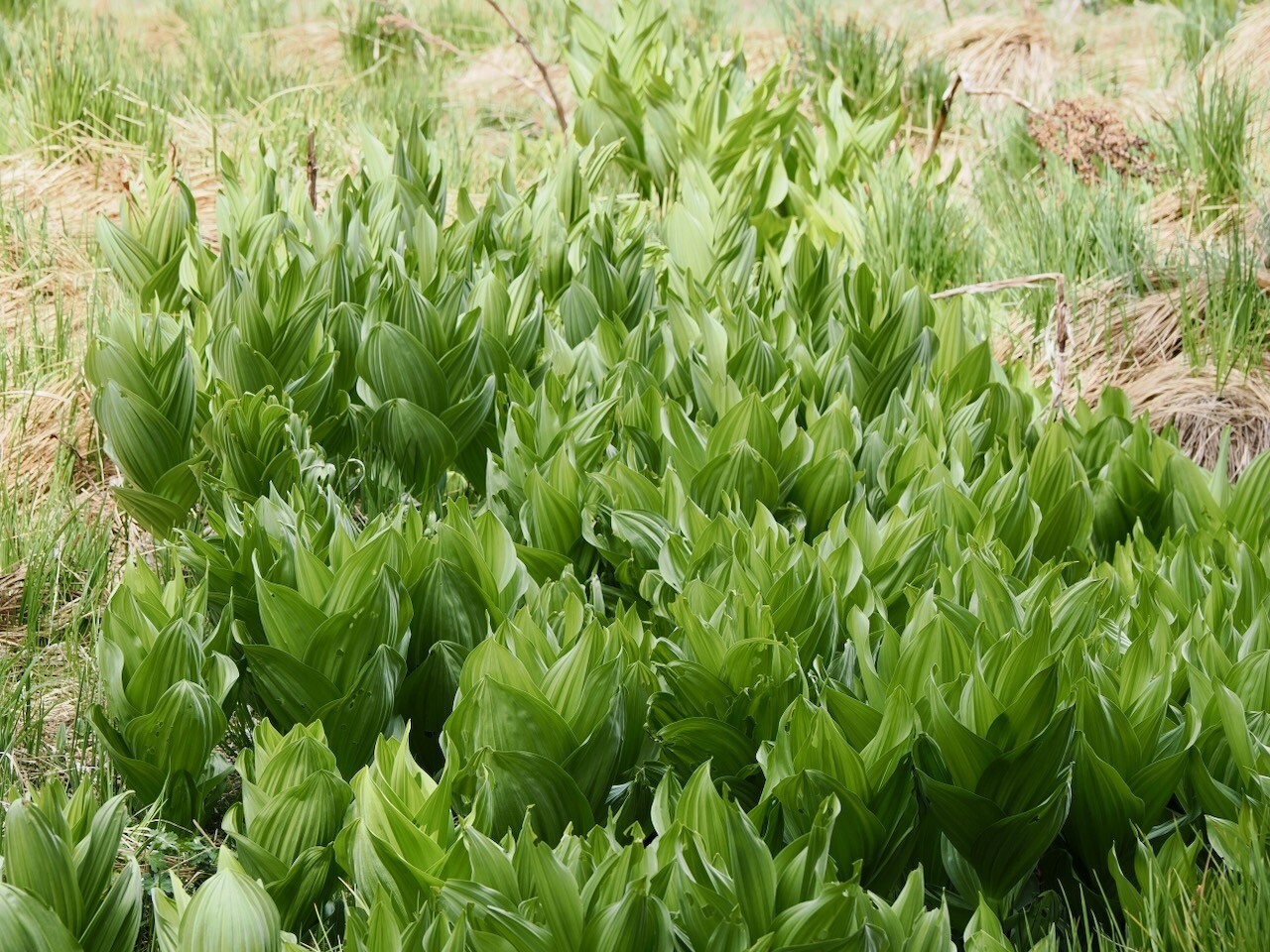
I was off building a primitive shelter with rope and knots when I heard the commotion. One after another, my fellow scouts were clutching their stomachs — poisoned by Veratrum californicum, California corn lily, a toxic plant so similar in appearance to the eastern skunk cabbage that early explorers had named the meadow after it. There is not a single skunk cabbage plant south of Oregon, but the place name persists. And so, roughly every five years, a new group of scouts replays the same scenario.
The map was wrong. The territory didn't care. That lesson — that the handbook drawn three thousand miles away cannot substitute for knowing the plants under your feet — has informed every instrument I've ever built and every question I've ever asked about the living world. Foxworthy argues that taking a parasitic or extractive orientation requires an extraordinary bet: that you can identify which parts of the system you need and safely discard the rest. I learned this at thirteen, on my knees next to a boy with a stomach full of corn lily.
The Druid's Prayer and the Philosopher's Arrow
Twenty-seven years later, in the summer of 2000, I was directing the James San Jacinto Mountains Reserve, writing dispatches under the title "Chronicles of a Modern Pict" — named for my persona in the Society for Creative Anachronism, the Pictish druid Broichan maqq Kynat. In those chronicles I described solstice rituals at places the Cahuilla people had used for ceremonies for perhaps thousands of years, and a turkey vulture that circled above me while I sang a Cahuilla bird song at the moment of the summer solstice.
And I adopted a Druid prayer I had found in one of my reference books:
All the Gods are One God, All the Goddesses are One Goddess, All the Faiths are One Faith, All Things are Interconnected, And Truth is Whole.
Reading Foxworthy's essay this morning, I realize that this prayer — embraced from a felt sense of the world rather than a philosophical argument — is the arrow of integration compressed into five lines. All Things are Interconnected is his structural claim about layers of complexity cohering with and sustaining what came before them. Truth is Whole is his argument that accurate representation of an integrated reality is itself integration operating at the level of mind.
I did not need Foxworthy's framework to live inside this orientation. But his framework gives it something my prayer could not: a rational foundation that any mind — including an artificial one — might arrive at independently through observation of the physical world.
The Parasite Problem
Foxworthy uses parasitism as his primary example of what integration is not. Cancer is complex but parasitizes the body. Propaganda networks are complex but parasitize the information ecosystem. His clean distinction — integration builds, parasitism extracts — provides a sharp analytical knife.
But I spent the last decade of my career at the University of California's Blue Oak Ranch Reserve, where some of my favorite researchers were parasitologists. Chelsea Wood and Pieter Johnson published a landmark paper, "A World Without Parasites," that complicates Foxworthy's framework in ways I think make it stronger.
Their thought experiment reveals that biological parasitism is not mere extraction. Remove rinderpest — a cattle virus — from the Serengeti and you trigger a cascade: herbivore populations explode, grazing intensifies, fire frequency decreases, woody plants increase, and the entire ecosystem shifts from carbon source to carbon sink. Certain parasitic worms hijack the brains of crickets and drive them into streams to drown — delivering a critical food subsidy to fish and the entire aquatic food web. Parasites represent roughly forty percent of described species and, in some estuaries, their biomass exceeds that of top predators.
The ecologist's correction to the philosopher: the arrow of integration is real, but at every scale the clean binary dissolves. The parasite is the integrator. The defector is part of the cooperative layer. Science is wonderfully fractal this way — drill deeper and you find new complexity that doesn't contradict the large-scale pattern but refuses to be simplified by it.
Parasites We Built
Where Foxworthy's framework bites hardest is not in biology but in civilization. We have not eliminated our parasites. We have built new ones and given them corporate charters. A cooperative system can absorb some freeloaders, but past a certain threshold the whole thing unravels. We have built economic and political systems that reward parasitism and call it success. The corporation that dumps its true costs onto the environment outcompetes the one that pays its own way. The politician who fragments public understanding gains power over the one who integrates it. We have pushed ourselves into a state of accelerating instability where parasitic structures stress civilizations precisely as unregulated animal populations overshoot their resources and crash.
And here is the structural problem: we are an apex species that has systematically removed its own regulators — predators, diseases, resource limits — without replacing them with anything functionally equivalent. We have achieved, for ourselves, exactly the "world without parasites" that Wood and Johnson warn would be deeply destabilized. Meanwhile, Foxworthy's essay, written for the educated middle, doesn't reach the millions living on the edge of survival who already know what integration's absence feels like in their bodies, nor the oligarchs who embody the parasitic elephant in the room. The arrow may be observable by any sufficiently intelligent mind, but observability means nothing when the parasitic layer has privatized access to meaning itself.
The Instrument and the Practice
Foxworthy closes with what I think is his strongest and most vulnerable passage. The real work, he says, is "the practiced frameworks, the daily disciplines, the communal structures that actually form people into the kind of beings who orient toward integration rather than extraction." Religions understood that the practice is the medicine.
He's right. And he earns the claim with a brave personal disclosure — his own descent into addiction and the twelve-step program that rebuilt him by reorienting from a closed system maximizing pleasant states to a participant contributing to something beyond himself. But twelve-step programs are recovery from crisis. The question his essay leaves open is what the daily practice looks like for people who aren't rebuilding from the ground up — the ongoing disciplines that maintain integrative orientation before the crisis arrives.
I am not a philosopher. I am a curious fellow whose happiest moments are in nature and at a workbench. But I have the practices. The daily walk along the bluff above the Willamette. The instruments — weather stations, acoustic sensors, air quality monitors — feeding data to a system I call the Macroscope that assembles ecological narratives from what the sensors report. And an experimental architecture called SOMA — a network of simple computing elements that learns what "normal" feels like for a landscape by settling into the patterns of its sensor streams. When a familiar bird goes silent, or the temperature and humidity stop behaving the way they usually behave together, the network doesn't flag a rule violation. It registers tension — the way you feel something is off in a familiar room before you can say what changed. Closer to perception than calculation.
In Native American traditions — traditions I encountered intimately during twenty-six years living among Cahuilla sacred sites — "medicine" does not mean curing illness. It refers to your particular gift, your way of participating in the web of relationships that includes animals, plants, landscape, and sky. You don't have medicine in isolation. It emerges from right relationship with the systems you're embedded in.
When Foxworthy says the practice is the medicine, he is reaching toward this older understanding. My medicine is observation. The workbench. The sensor network. The morning coffee with the data. The instrument that knows what it costs.
Recognition
I did not discover the arrow of integration this morning. I recognized it.
Foxworthy gave the arrow a philosophical framework. Prigogine gave it thermodynamic rigor. Wood and Johnson gave it ecological complexity. The Cahuilla gave it a blue lizard that rode a sunbeam to Earth and climbed as high as it could toward home. And I have been walking in its direction since a thirteen-year-old boy learned, the hard way, that the map is not the territory.
AI has been, for me, a window into places previously blocked by the walls of my own capabilities and time. Not an agenda. A workbench tool that lets curiosity reach further than it could alone. The arrow is real. It is also fractal, paradoxical, threatened by the parasitic structures we've built, and far more complicated than any single essay can contain.
But the practice continues. Tomorrow morning I will walk the bluff, check the instruments, and drink my coffee. The arrow points toward something rather than nothing. And truth, as the druid says, is whole.
References
- - Foxworthy, W. Alex (2026). "The Arrow and the Leap: Towards a Shared Framework of Meaning for Humans and AI." *3 Quarks Daily*. https://3quarksdaily.com/3quarksdaily/2026/04/the-arrow-and-tards-a-shared-framework-of-meaning-for-humans-and-ai.html ↗
- - Wood, Chelsea L. and Pieter TJ Johnson (2015). "A World Without Parasites: Exploring the Hidden Ecology of Infection." *Frontiers in Ecology and the Environment* 13(8): 425–434. ↗
- - Foxworthy, W. Alex (2026). "What Prediction Feels Like: From Thermodynamics to Mind." *3 Quarks Daily*. https://3quarksdaily.com/3quarksdaily/2026/02/what-prediction-feels-like-from-thermodynamics-to-mind.html ↗
- - Prigogine, Ilya (1977). Nobel Prize Lecture: "Time, Structure and Fluctuations." Nobel Foundation. https://www.nobelprize.org/prizes/chemistry/1977/prigogine/lecture/ ↗
- - Hamilton, Michael P. (2026). "Towards an Ethical AI." *Coffee with Claude*. https://coffeewithclaude.com/post.php?slug=towards-an-ethical-ai ↗
- - Hamilton, Michael P. (2026). "Intelligence at the Edge." *Coffee with Claude*. https://coffeewithclaude.com/post.php?slug=intelligence-at-the-edge-1774881038 ↗