The Kettle
Yesterday we arrived twenty minutes too late. The kettle had already formed and dispersed. We saw Turkey Vultures riding the thermals, a Cooper's Hawk, Ravens in flight — but the Swainson's Hawks had committed to the air and gone north without us.
This morning we got it right.
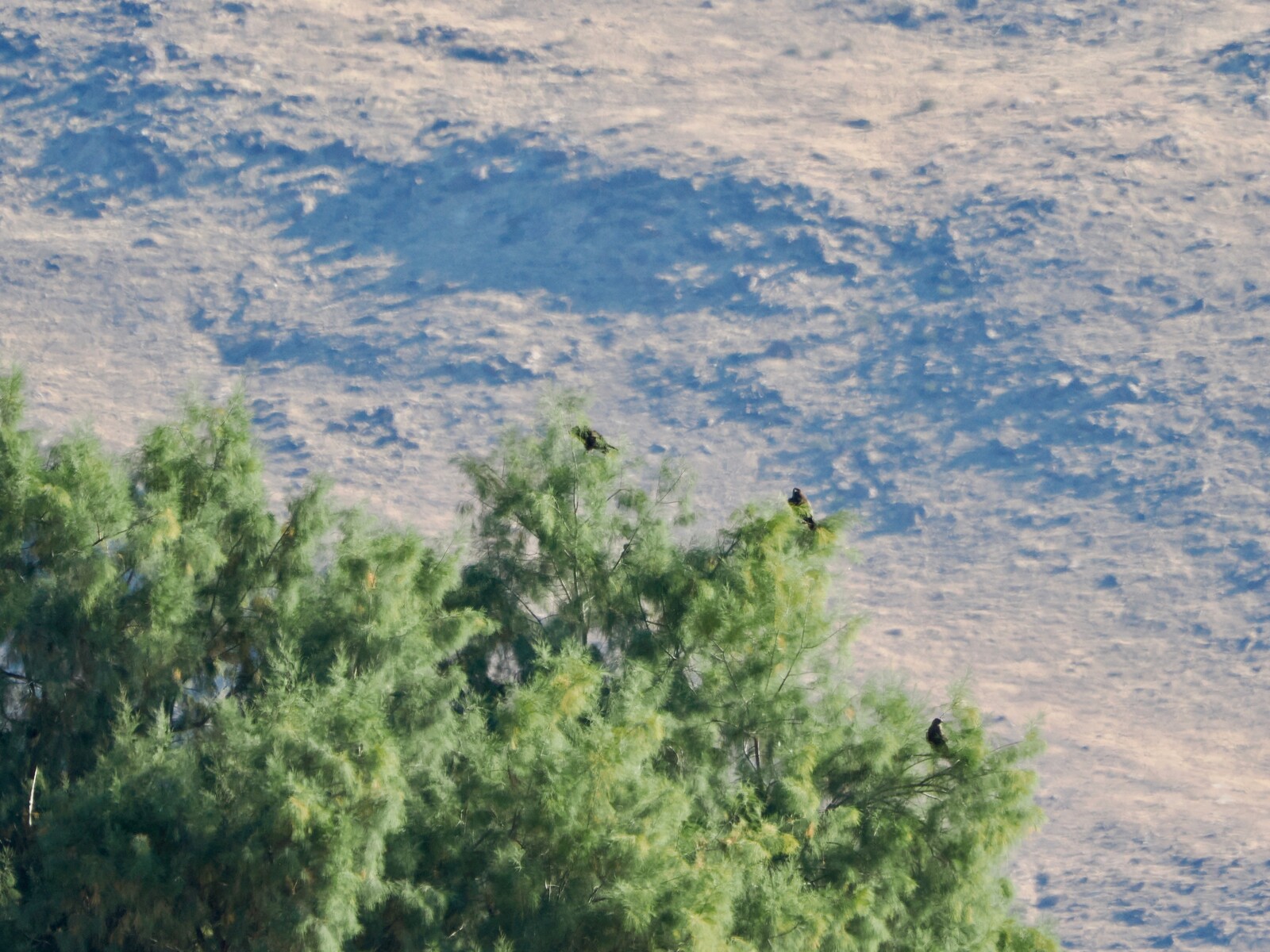
Merry and I pulled into the hawkwatch site at eight-thirty. The scene that greeted us was unlike anything I had witnessed in our previous visits. Dozens of Swainson's Hawks were perched in the crowns of tall tamarisk trees and fan palms in a wide radius around the observation point — dark shapes scattered across the canopy like ornaments, motionless, waiting for the air to change. I had written about this species all week, attended a lecture on their breeding ecology, watched them circle over Font's Point while learning of Paul Ehrlich's death, and arrived too late to see them launch. Now here they were, close enough to study through binoculars, and the morning was still cool enough that nobody was going anywhere.
About ten dedicated hawkwatch volunteers were already at their stations. Some had been coming out every morning for weeks. They had their spotting scopes trained on the horizon and their binoculars sweeping the treeline, counting perched birds, calling out when one jumped or glided between treetops. The Borrego Springs Hawkwatch has been running every spring since 2003 — twenty-three years of season totals recorded by people standing in the desert with optics and patience. This is our last week in the Borrego Valley — the hawkwatch continues into early April — and the count this year is tracking in the low one-thousands, potentially among the lowest in the history of the watch. Nobody knows why. But the volunteers were here, and the birds were here, and the desert floor was beginning to heat.
The anticipation was physical. You could feel it in the observers and, I believe, in the birds — a shared attention directed at something not yet visible. The thermal column that would carry these hawks northward hadn't formed. The sun climbed. The air was still. We waited.
Then someone called out: "First kettle."
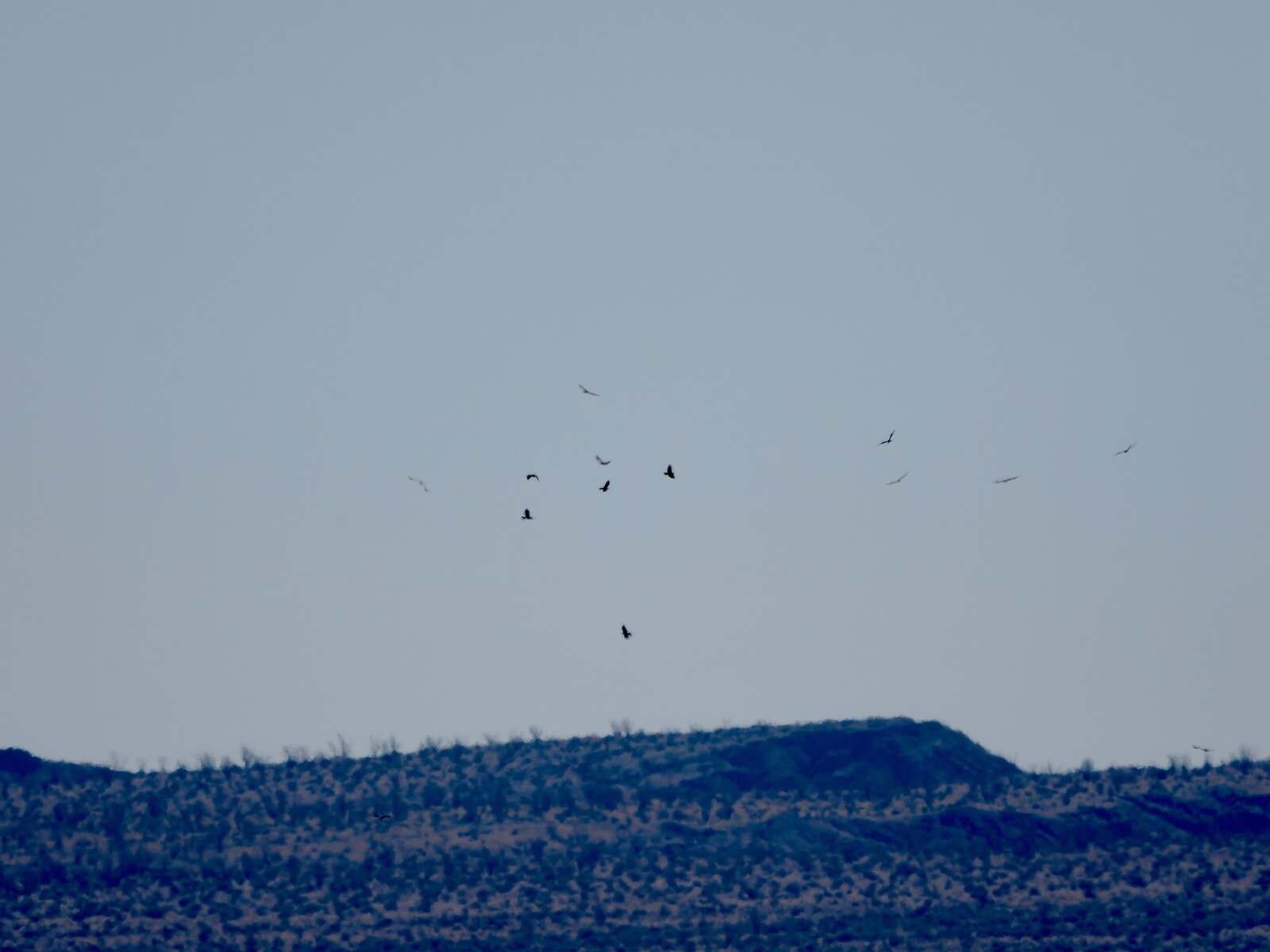
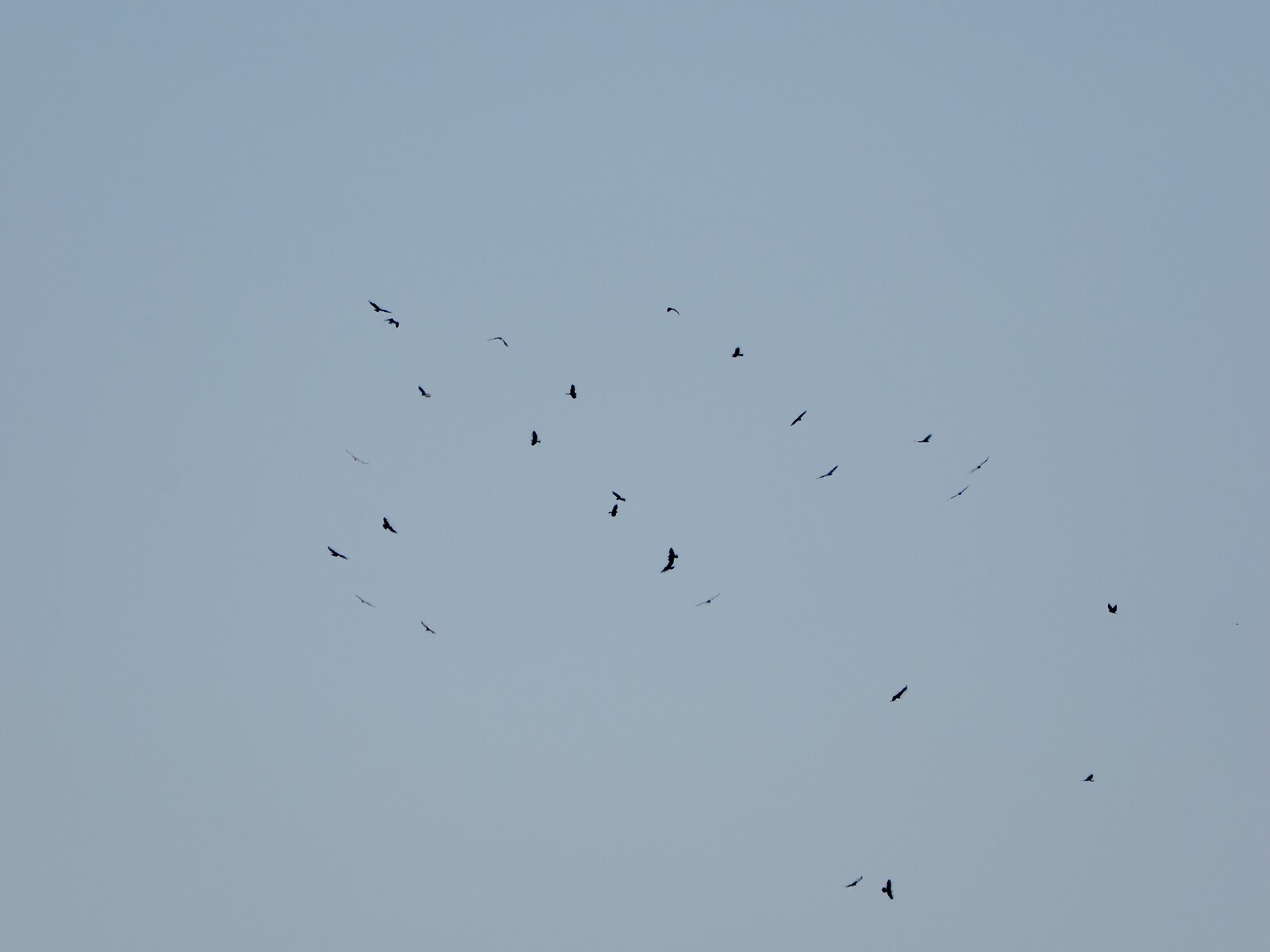
Every scope and pair of binoculars swung. Against the blue sky to the south, dark shapes were circling — and more were joining, an almost fluid stream of particles drawn upward into a tightening spiral. The designated counters began calling their accumulating numbers: ten, fifteen, twenty, thirty, forty. The kettle was building fast, birds streaming in from perches across the valley floor, converging on a column of rising air that none of us could see but all of them could feel.
Soon multiple kettles were sighted. The nearby birds began launching from their tamarisks, and suddenly Swainson's Hawks were in nearly every direction — rising on thermals, gliding between columns, streaming overhead. The slow vortex of a kettle seen from below is one of the great spectacles of avian ecology. Birds spiral upward in a widening gyre, wings held in the shallow dihedral that marks this species, rising without flapping on air alone. They gain altitude — a thousand feet, two thousand — until they reach the height they need. Then, one by one, they peel off and stream northward on a glide, losing altitude gradually until they find the next thermal and the process begins again. It is driven entirely by physics, and it is entirely beautiful.
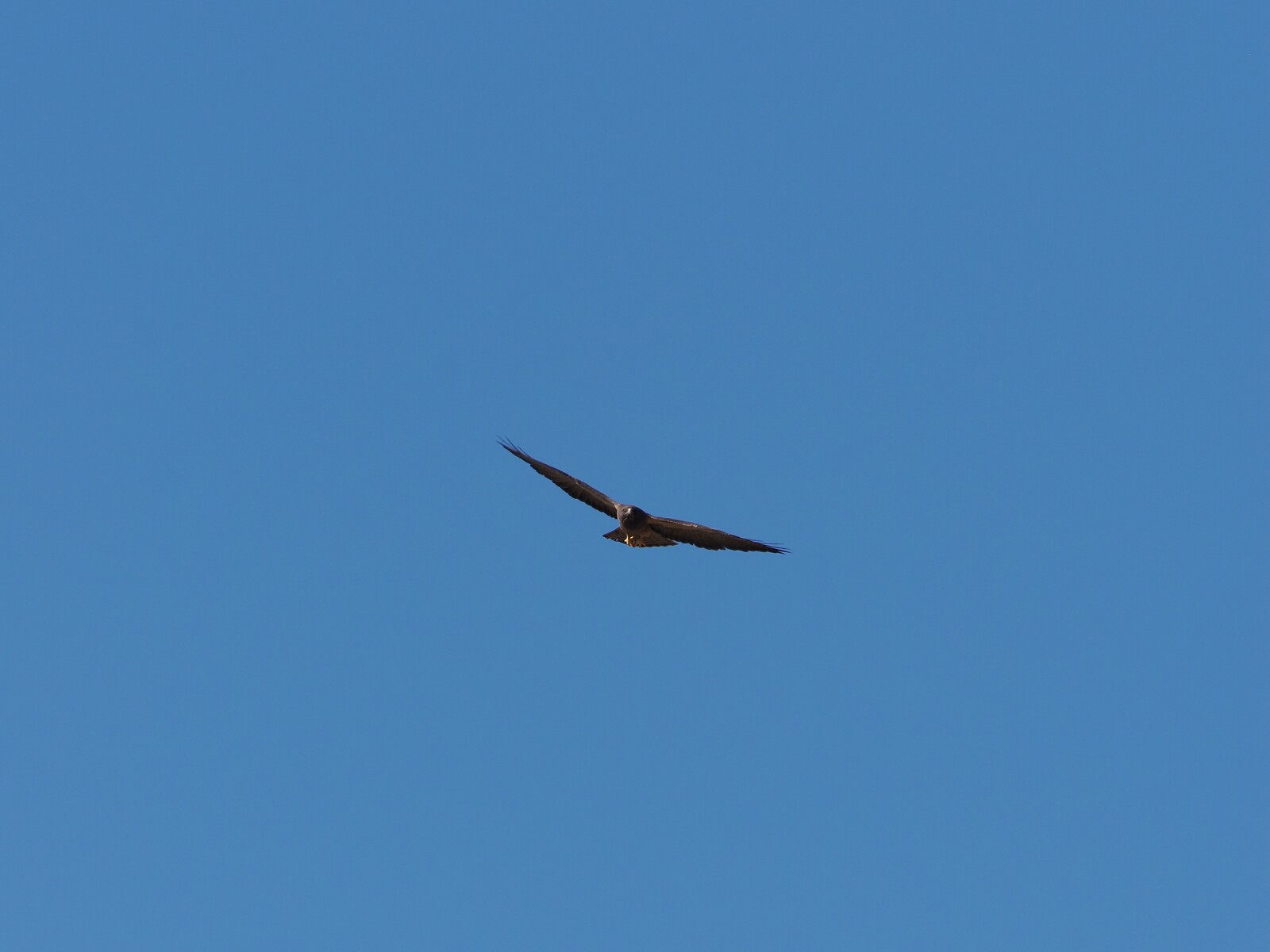
As the birds streamed overhead, some passed close enough that I could see the fine details I had only known from field guides and Lizzi Meisman's slides two days earlier: the dark flight feathers against the lighter underwing coverts, the rufous chest of the light morphs, the pale throat, the dark eye. Swainson's Hawks have long, narrow wings relative to their body mass — a high aspect ratio that maximizes lift-to-drag in soaring flight. They are engineered by natural selection for the thermal column the way a sailboat is designed for wind. Watching them work the air from directly below, that engineering is not metaphorical. It is visible in every line of the animal.
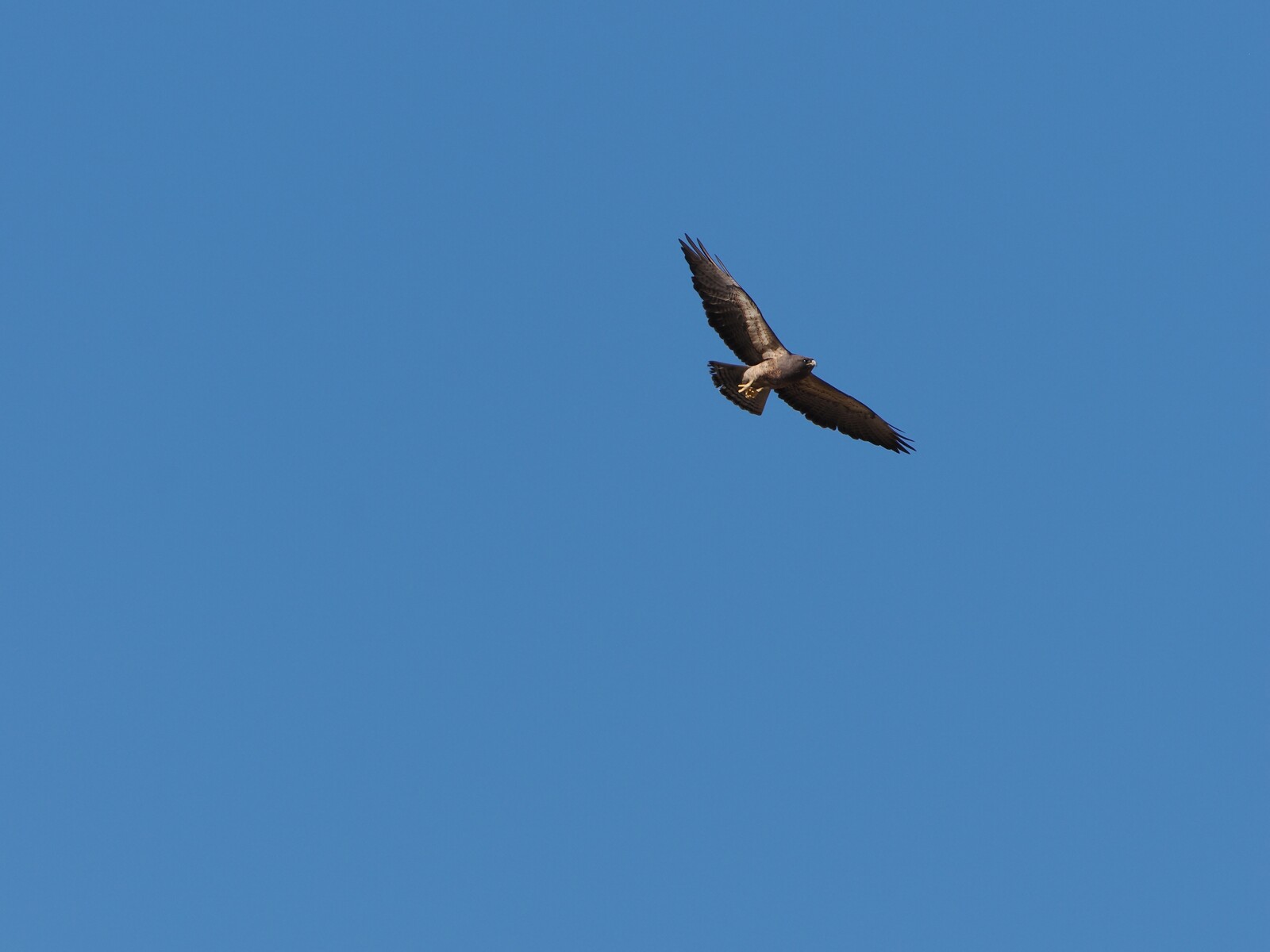
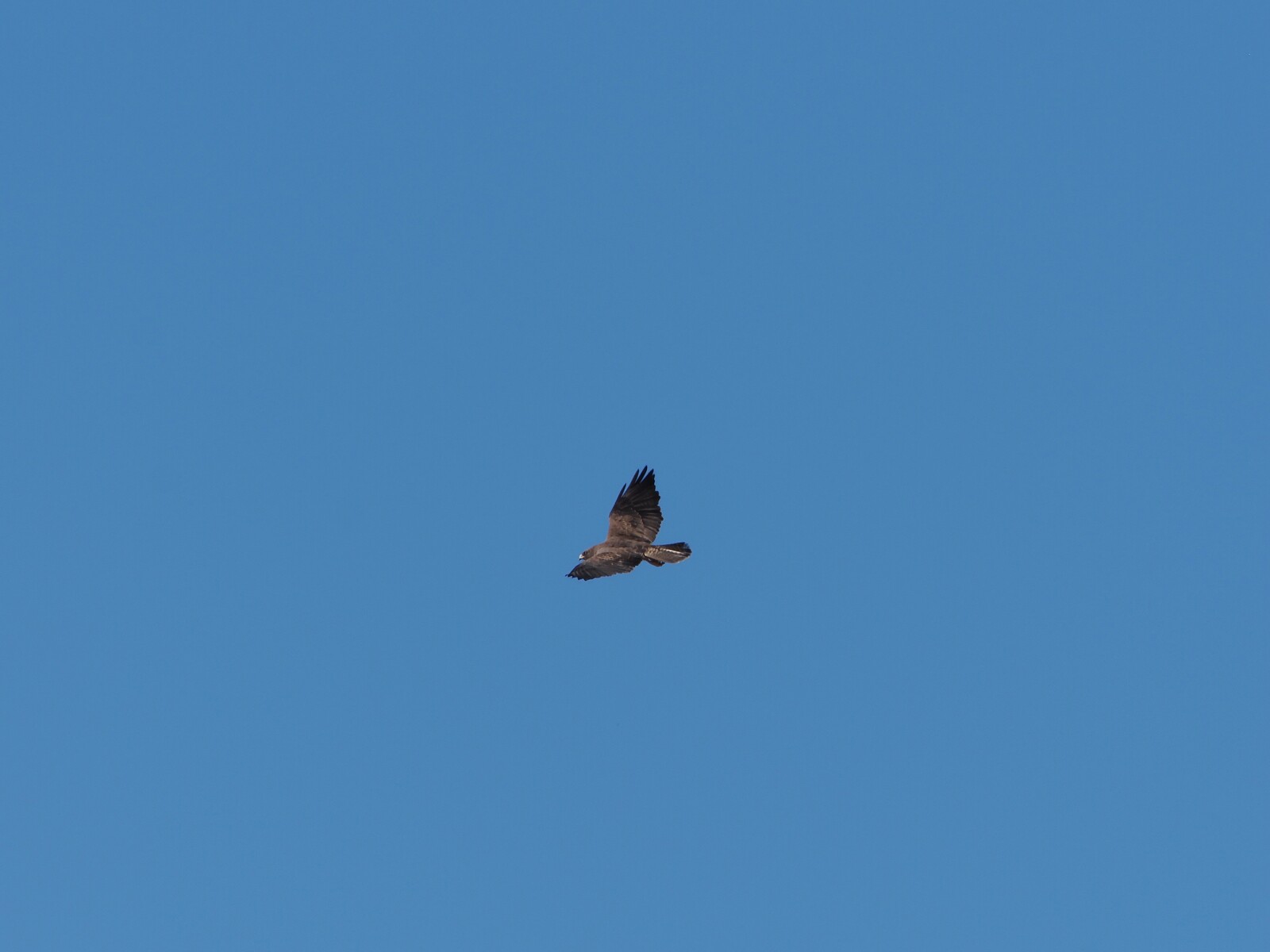
I shot frame after frame. Birds perched in the tamarisks with the desert mountains rising behind them. The kettles building against the sky — thirty or more birds swirling in a single column. And then the close passes, individual hawks winging north against the backdrop of the Santa Rosa Mountains, close enough to see the barring on their tails. One image caught a Swainson's Hawk in full soaring profile against a granite peak, wings spread wide, more than twelve-thousand-mile migration compressed into a single frame.
We were so close that Merry, tracking a bird through her binoculars, watched it snatch a flying insect out of the air with one talon, then bend its head down to eat without breaking stride — not unlike a commuter consuming a breakfast burrito on the way to work. Swainson's Hawks are insectivores for much of their annual cycle, shifting to a diet of grasshoppers and dragonflies during migration and on the wintering grounds. What Merry witnessed was a twelve-thousand-plus mile traveler refueling on the wing, a moment of ordinary competence inside an extraordinary journey.
The energy among the observers matched the energy in the sky. These were people who had invested weeks of early mornings in an activity that often produced modest returns — a handful of birds here, a distant kettle there, some mornings nothing at all. This was the morning it all came together. Counters called numbers. Scopes tracked the kettles as they dissolved into streams of birds heading north. People grinned at each other. Someone said quietly, almost to herself, "This is why we come out."
She was right. This is why anyone comes out. Not for the guarantee of spectacle, but for the chance of it — earned by the mornings when you see nothing, or arrive twenty minutes late, or stand in the heat watching an empty sky. The Borrego Springs Hawkwatch has accumulated twenty-three years of data not because every morning is like this one, but because the volunteers show up regardless. That's the discipline that makes the data real. The spectacular mornings are the reward, but the quiet mornings are the science.
Swainson's Hawks travel nearly fourteen thousand miles round trip between the Argentine pampas and their breeding grounds in western North America. The Borrego Valley is one of the staging areas on the northbound leg, a place where desert thermals provide the lift the birds need to gain altitude for the long glides north. The heat dome that has been building over the Southwest this March — pushing temperatures above ninety degrees in a season that should still be in the seventies — is an anomaly for humans and an engine for hawks. They need the warm air to rise. The same atmospheric conditions that signal a changing climate provide the energy these migrants depend on. There is an uncomfortable elegance in that.
Somewhere to the north, the Butte Valley is waiting — juniper steppe and irrigated fields, nest trees that have been occupied for forty years, and a young scientist named Lizzi Meisman trying to understand why some of them fail. Two days ago, I sat in a library and listened to her describe the gaps in her data. This morning, I stood with the volunteers and watched the birds she studies begin the last leg of their journey to the breeding grounds she monitors. The thermal column connects them: the winter range, the migration corridor, the breeding grounds, the science, the watching.
By ten o'clock, the sky was empty. The hawks had risen, streamed, and gone. According to the field notes logged on hawkcount.org — the Hawk Migration Association of North America's official database — the migration window this morning lasted from 8:44 to 9:15. Thirty-one minutes. The final count: 229 raptors — 217 Swainson's Hawks and 12 Turkey Vultures. The entire spectacle we had witnessed, from first kettle to empty sky, had unfolded in half an hour. No wonder we missed it yesterday.
The season totals through today tell the larger story: 738 Swainson's Hawks and 181 Turkey Vultures for February and March 2026. On a season tracking toward a historic low, this morning's 217 Swainson's represented nearly a third of the entire season count in a single half-hour burst. The birds are still out there, still moving, still reading the air. But they are passing through in pulses, not streams, and the pulses are brief. The volunteers began packing their scopes. The desert settled back into its heat and silence. Merry and I drove back to Borrego Springs with the windows down.
Our time in the Borrego Valley is nearly over. The hawks and the volunteers will continue without us. But this morning, for thirty-one extraordinary minutes, the sky was full of them — and we were there.
Epilogue: The hawkwatch leaders report that Betsy — the young Swainson's Hawk fitted with a GPS backpack by Dr. Pete Bloom last year in Borrego Springs — is expected to arrive by the end of the day or tomorrow. She has been tracking north along the west coast of Mexico, completing her second full migration loop. Two hundred miles a day is nothing to these masters of the air.