The Word Comes Home
The iPad on my desk sits open to a screen I wasn’t meaning to study. Four tiles in a quiet grid: Health, Home, Maps, Weather. These are Apple’s developer kits — each a platform on which thousands of applications are built, each one a structured way for a small company somewhere in the world to speak to the device in my hand about a particular corner of a person’s life. The grid is elegant. What caught my eye, the way a naturalist’s eye catches things, was what wasn’t in it.
No Nature. No Learning.
A naturalist’s eye is trained to notice what isn’t there as keenly as what is. The missing tree species in an otherwise healthy stand. The gap in a dawn chorus where a particular song used to land. The absence is often more diagnostic than the presence. Yesterday morning, the absence in Apple’s grid was telling me something about the shape of my own work, and about three things that have happened in the last two weeks that I want to walk you through.
A word from home
On April 7, at a symposium at the Lawrence Hall of Science in Berkeley, the University of California Natural Reserve System relaunched itself as UC Nature. I spent thirty-six years working inside that system. When I started my career it wasn’t yet called the Natural Reserve System — it was the UC Natural Land and Water Reserve System, UCNLWRS, a mouthful of inventory language that named the network by what it held. Later it became the Natural Reserve System, UC NRS, and the emphasis shifted from the things on the land to the idea of the land being reserved for the serious, slow work of scientific investigation. And now, under a new executive director, the system has taken a third name, and this time the name is a single word.
Nature.
Steve Monfort, UC Nature’s executive director, described the relaunch as the front door for UC’s engagement with the natural world. The expanded scope reaches into climate and biodiversity, into landscape-scale coordination, into community resilience and partnerships with Tribal Nations, and into — the phrase that stopped me, because I had recently been standing inside one — the California Sentinel Sites for Nature initiative, which deploys sensors and standardized protocols to establish biodiversity baselines across the reserve network. UC Nature reserves host more than a third of those sites.
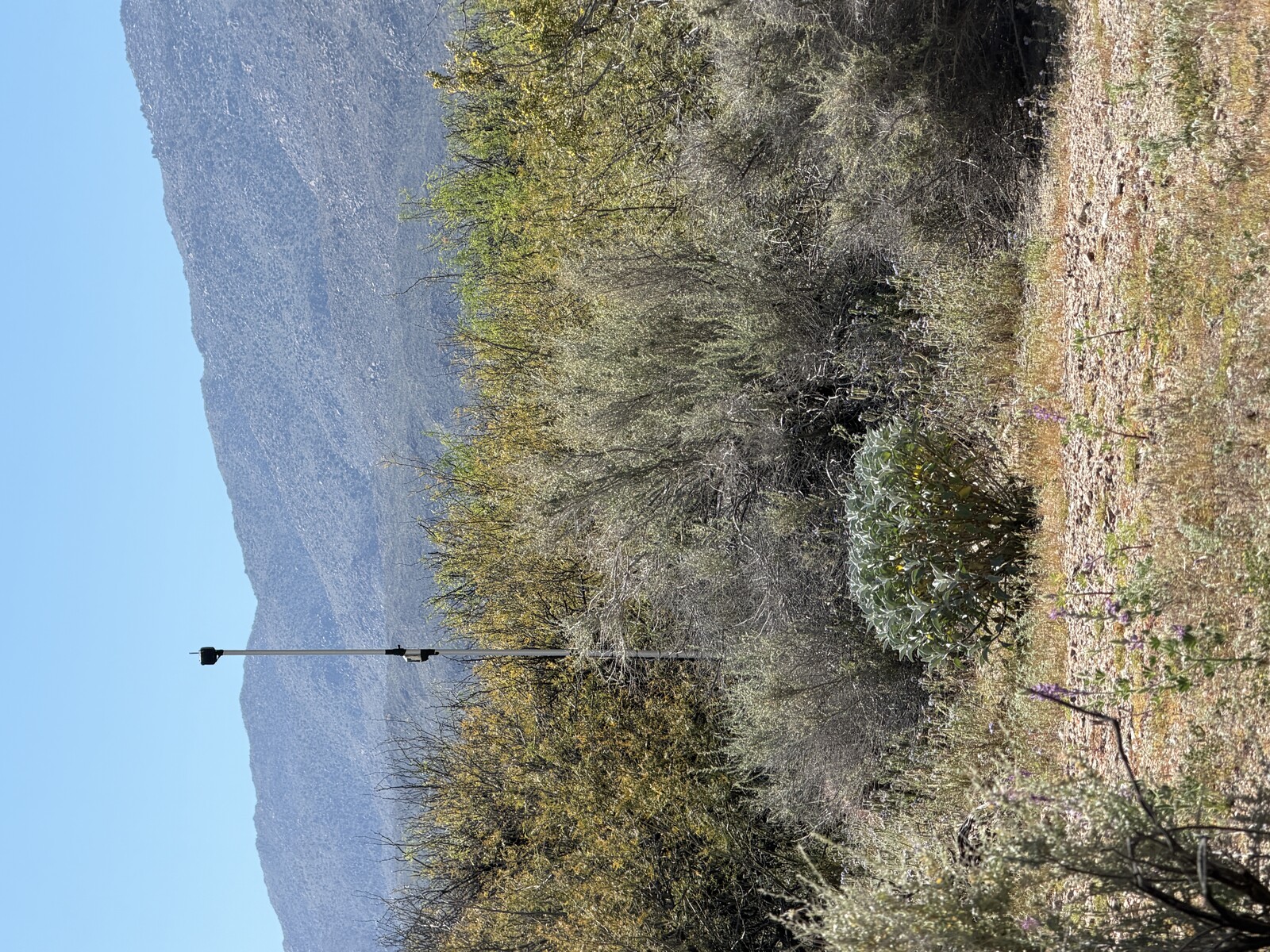
I was at Steele/Burnand Anza-Borrego Desert Research Center in March with my partner Merry and a new 360-degree camera, working on what will become an archive of high-fidelity spatial captures across some of the reserve sites I’ve known longest. At the time, I thought of what I was doing as Canemah-local work with a field trip attached. What I now understand, two weeks on, is that I was working on a Sentinel Site before the institutional language for it was in place.
Three names across a career. UCNLWRS, UC NRS, UC Nature. When I started, the system was named by what it contained. Now it is named by what it is. The word has come home.
Company at the door
On April 17, ten days after the Berkeley symposium, I sat down with the leadership team of the Virtual Field Research Coordination Network — a project of the Organization of Biological Field Stations — and gave them a demonstration of yea.earth, the place-based interface we’ve been building here at Canemah. These were colleagues I first connected with in 2021, people who have spent careers thinking about field station cyberinfrastructure from the inside.
Their response was not what I expected.
It was recognition. They saw what I had been building and named it as something the wider community needs. We discussed, with some specificity, what deployment at other stations might look like. The meeting ended with an invitation: come to the RCN’s annual meeting in May, in Newport, Oregon, at the OSU Hatfield Marine Laboratory. Bring the demonstration with you.
For years I have built this work in a small laboratory in Oregon City for an audience of one — myself, and you, the readers who have kept me company through these essays. Last Friday the door opened, and a handful of serious people walked up to it and asked to come in.
The pattern clicks into place
Back to my iPad.
The reason the grid of four tiles suddenly meant something yesterday is that I had two pieces of new information I didn’t have a month ago. I had the UC Nature rebrand, which tells me that a major public university has officially named the domain of Nature as worthy of a front door — a platform, in other words, rather than a category of assets. And I had the RCN meeting, which tells me that the field station community is probably ready for a shared substrate and might be willing to say so out loud.
Two pieces of evidence that the word Nature is becoming, in 2026, the kind of institutional word that Health and Home and Maps and Weather have been for the last few years. Not a topic. A platform.
And here is where the Macroscope enters the room, because the Macroscope is what a Nature platform substrate looks like when you actually try to build one. A place where sensor readings and species occurrences and atmospheric measurements and taxonomic references and spatial geometry and narrative documents all live together, so that a question can be asked once and answered from the full depth of the observational record. A place that can hold the cross-site federation that no single field station can manage alone. A place where the intelligence layer can read the data and generate the prose about the data at the same time.
That leaves the sixth tile, the one even UC Nature hasn’t yet named. Learning. The structured practice of inquiry — observation, hypothesis, investigation, result, reflection — that is what actually converts sensor data and natural-history observation into understanding. Apple cannot build this tile, because it is not a consumer category, yet. But our federal funder of basic research, the National Science Foundation, already organizes its programs along exactly this seam: STEM education (Science - Technology - Engineering - Math) on one side, Research Coordination Networks on the other. The federal structure has been pointing at the shape of the two missing platforms for years; it simply hasn’t been calling them platforms.
The next arc
This is the moment to tell you what’s next. Two things, really, that are one thing.
The first is that Coffee with Claude, the blog you are reading this on, is approaching its hundredth essay. When that essay lands I will close this chapter and open a new one at sciencewithclaude.com. The new platform — SWC — keeps the voice and the curiosity that have carried CWC, but moves from daily essay toward structured investigation. Fewer pieces, more depth, each one following a seven-phase arc from observation through analysis to reflection. The naturalist’s eye stays primary; the practice of human-AI collaboration moves from subject to method.
The second is that the Macroscope itself is undergoing its next generational shift. The current version has served me well for a number of years on an architecture that was capable but limited. The next generation — which I’ll refer to here simply as Macroscope 2.0 — moves to software designed from the ground up to hold time, space, taxonomy, and meaning in one place. What that means, in terms you will feel rather than read about, is a Macroscope with genuinely global reach; with fluid powers-of-ten navigation that lets a user zoom from a single sensor reading or organism observation to a continental pattern and back without the machinery creaking; and with an intelligence layer that can read the archive’s narrative alongside its numbers. The technical details belong in my laboratory notes, not here. What belongs here is the commitment: the new substrate is what makes the platform possible.
SWC will be the publication venue for what the new Macroscope allows us to investigate. The two are not sequential. They are a single move forward.
What the eye sees
I’ll close where I began, at my desk and looking at my iPad.
A naturalist’s eye, trained over decades, does not usually see what it is looking for. It sees what is there, which is often not what one expected and sometimes more than one hoped for. What I saw yesterday, in a grid of four tiles on a tablet screen, was not a gap in Apple’s product line. It was a geometry — four consumer platforms, one newly named university platform, one federally supported but unnamed learning practice, and a small laboratory in Oregon City that happens to be building precisely at the junction of the two domains nobody else could reach.
Three institutional names across one career. The word has come home.
I’ll see you at the hundredth essay. And then, I hope, at the front door.
References
- - California Sentinel Sites for Nature (2026). “Sentinel Sites for Nature.” *CA-SSN*. https://cassn.org/ ↗
- - The Virtual Field (n.d.). “Research Coordination Network: RCN-UBE Incubator — Broadening Student Access to Field Experiences using The Virtual Field Platform.” *The Virtual Field*. https://thevirtualfield.org/about/research-coordination-network/ ↗
- - Hamilton, M. P. (2026). “yea.earth — Your Ecological Address.” *Canemah Nature Laboratory*. https://yea.earth/ ↗
- - UC Nature (2026). “Introducing UC Nature.” *UC Nature*. https://ucnature.org/introducing-uc-nature/ ↗