
Why Can’t You Remember Tomorrow?
It’s a child’s question, the kind that stops parents mid-sentence. You remember yesterday. Why not tomorrow? The honest answer—nobody fully knows—sounds like evasion. But it isn’t.
I’ve spent fifty years studying how ecosystems change through time. Forests succeed through stages. Populations rise and fall. Climates shift. The direction is always the same: past to future, never reverse. We swim in time like fish in water, so constantly immersed we forget to notice it.
But this morning, reading about a particle detector that high school students can build for a hundred dollars, I was reminded how strange time actually is.
Twenty kilometers above your head, right now, cosmic radiation is slamming into the atmosphere. These are particles born in supernova explosions, accelerated by forces we’re still mapping, traveling for millions of years before arriving here. When they hit air molecules, they shatter into showers of secondary particles. Among these are muons—heavy cousins of electrons, moving at nearly the speed of light.
Here’s the problem. A muon lives for about two millionths of a second. Even at near-light speed, that’s enough time to travel maybe 600 meters before it decays. The muons are born 20 kilometers up. They have no business reaching the ground.
But they do. Millions of them, every minute, passing through your body right now as you read this.
The explanation is time dilation—Einstein’s prediction, confirmed countless times. For the muon, traveling so fast, time runs slow. From its perspective, it lives a normal brief muon life. From our perspective, watching from the ground, its clock stretches. Both perspectives are correct. There’s no “real” time against which to measure them.
This still staggers me. Not the mathematics, which I can follow well enough. The fact. Time itself—the medium in which everything happens—runs at different rates depending on how you’re moving through space. The GPS satellites in orbit experience this; without corrections for time dilation, your phone’s map would drift by kilometers per day. The engineers didn’t include those corrections because Einstein was a famous physicist. They included them because without them, the system doesn’t work.
And it goes deeper. A paper published last month in Physical Review Letters proves something that physicists have long suspected: quantum correlations across time behave differently than quantum correlations across space. We’ve known since Einstein that entangled particles can be correlated across vast distances—measure one, and you instantly know something about its partner, no matter how far apart they are. Spooky, but symmetric. The two particles are interchangeable partners in the strangeness.
Time doesn’t work that way. The researchers showed that when quantum systems are correlated across time rather than space, the mathematics produces signatures that spatial correlations simply cannot. There are markers—negative values in the equations where probabilities should live—that only appear when time is involved. The past and future aren’t interchangeable the way left and right are. Even at the most fundamental level physics can probe, time is special.
Why? Here the ground gets speculative. One physicist proposes that what we experience as time’s flow is actually spacetime solidifying—like water freezing into ice, but along a dimension we can’t directly perceive. The past is frozen, fixed, done. The future hasn’t crystallized yet. The present moment is the advancing edge where possibility becomes actuality, a crystallization front moving forever forward.
I find this image haunting. It suggests the past isn’t gone—it’s preserved, locked into the structure of existence like insects in amber. And the future isn’t somewhere we’re traveling toward—it’s something that hasn’t yet become real. We don’t move through time; time congeals around us.
Whether this speculation survives contact with experiment remains to be seen. Physics is littered with beautiful ideas that turned out to be wrong. But the core mystery persists: time has properties that space doesn’t, and we experience this every moment without understanding why.
What I find hopeful is that the inquiry spans every scale. High school students with hundred-dollar detectors can watch muons arrive—particles whose impossible survival proves time bends. Theorists at research universities fill blackboards with equations that reveal time’s quantum strangeness. And all of us, lying awake at 3 AM, know in our bones that yesterday is irretrievable and tomorrow is uncertain in ways that “over there” simply isn’t.
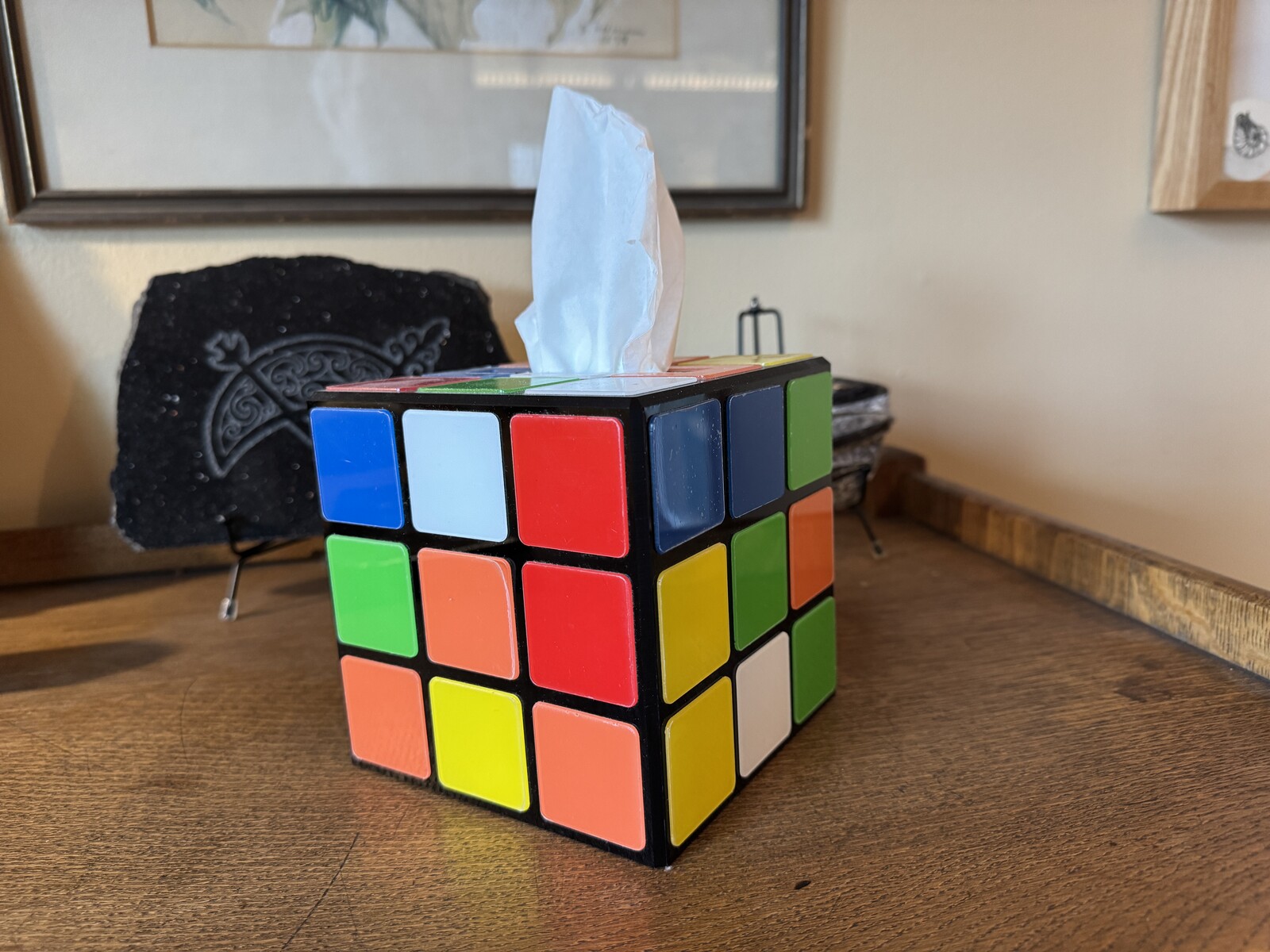
My granddaughter Madeleine is eleven, an aspiring speedcuber who thinks in algorithms. She’s working toward solving a Rubik’s cube in under a minute—she compares times with her school friends and with her dad, whom she’s teaching. The cube is a perfect little laboratory for reversibility: scramble it any way you like, the solved state is always recoverable if you know the moves. No information is lost. Any scramble can be unscrambled.
But she can’t unscramble an egg. None of us can. Time’s arrow points one direction, and every kitchen demonstrates it. The cube is a toy that happens to be time-symmetric. The egg is reality, which isn’t. Madeleine already knows this difference in her hands, even if she hasn’t thought about it in those terms.
Someday I’d like to show her a muon detector. Not to explain differential equations, but to let her hold the strangeness directly: particles that shouldn’t exist at sea level, arriving constantly, proving that time isn’t what common sense suggests. The same intuition that lets her see cube algorithms might help her feel how strange it is that those particles survive their journey.
Maybe she’ll ask why she can’t remember tomorrow. I still don’t have an answer. But I’ve learned to love the question. It connects a child’s bedtime puzzlement to the deepest problems in physics, through fifty years of watching forests change and muons fall and moments crystallize into memory.
The direction is always the same. We don’t know why. But we can pay attention to it—and that attention, sustained across a lifetime, is its own kind of answer. The muons keep falling. The eggs stay scrambled. And every morning, the past grows larger while the future remains stubbornly dark.
We remember yesterday. We can’t remember tomorrow. The universe, it seems, is keeping that asymmetry close to its chest.
References
- - Strubbe, F. A five-dimensional classical framework for gravitational and quantum phenomena. Sci Rep (2025). https://doi.org/10.1038/s41598-025-32860-8 ↗
- - Lie, S.H. & Fullwood, J. (2025). “Multipartite Quantum States over Time from Two Fundamental Assumptions.” *Physical Review Letters*, 135, 230204. https://doi.org/10.1103/PhysRevLett.135.230204 ↗
- - Axani, S.N., Sarfraz, M., Garcia, M., Owens, C., Frankiewicz, K., & Conrad, J.M. (2025). “CosmicWatch: The Desktop Muon Detector (v3X).” arXiv:2508.12111. https://arxiv.org/abs/2508.12111 ↗